|
|
 |
Baldly Going Where We’ve Never Gone Before
Bald-Faced Lies Regarding Collapsing Global Demand
If I had a nickel for every time I’ve heard how reduced domestic U.S. demand for commodities was going to spell the end for Global Demand – I’d be rich already. In particular, over the past few months, the main stream financial press has been trumpeting that the real reason for prices of commodities being hammered into the ground is sagging Global Demand.
We can empirically see what a load of crap that’s turning out to be:
China Boosts Oil Imports to Record on Falling Prices
http://www.bloomberg.com/apps/news?pid=email_en&refer=china&sid=aku3hyO64O9M
Oct. 13 (Bloomberg) -- China, the world's second-largest energy user, increased crude-oil imports to a record last month, taking advantage of falling prices, as domestic refining capacity climbed.
Crude imports surged 46 percent to 20 million metric tons or 4.87 million barrels a day in September from a year earlier, according to Bloomberg's calculations based on figures provided by the Beijing-based Customs General Administration of China on its Web site today. August purchases were 15.65 million tons…..
[more.....signup] [open pdf....members] |
The Fall Rollout
With the Olympics better than half over and political season expected to shift into high gear with the commencement of the Democratic National Convention in Denver on Aug. 25, 2008 followed by the Republicans [Minneapolis-Saint Paul, September 1-4, 2008] - we can soon expect fall “roll outs” to begin making headlines.
Post Labor Day marks the count-down to the end of the current fiscal year [Sept. 30] in the U.S. and signifies the beginning of new seasons in everything from academics to advertising to the aforementioned politics – especially in a presidential election year.
[more.....signup] [open pdf....members] |
Fast Blast Gulf Coast Macro Energy Update
The extent of damages to America’s Gulf of Mexico energy infrastructure - have been grossly and egregiously under-reported. One can only posit that the true reason[s] for this had something to do with officialdom’s desire to maintain the illusion that “all is well” and exemplifies the lengths they will go to – to prevent stories of “shortages” and rising prices [inflation] from appearing in the mainstream media. [more.....signup] [open pdf....members] |
The Impending Receivership of the U.S.A.
My, how times have changed? As Bloomberg News reported Tuesday, September 24, 2008,
Eighteen months ago, U.S. Treasury Secretary Henry Paulson told an audience at the Shanghai Futures Exchange that China risked trillions of dollars in lost economic potential unless it freed up its capital markets.
``An open, competitive, and liberalized financial market can effectively allocate scarce resources in a manner that promotes stability and prosperity far better than governmental intervention,'' Paulson said.
Suddenly, it’s now become blindingly evident that “what’s good for the goose isn’t regarded as being so good for the gander”. It is exactly these types of conflicted pronouncements that hint at the true nature of what really afflicts America – treasonous deceit.
Portrait of a Financial Coup d’Etat
There’s been a growing consensus that the financial quagmire the U.S. is currently facing is wholly the result of the sub-prime / credit default swap [derivatives] issues plaguing financial institutions.
[more.....signup] [open pdf....members] |
And the Band Played On
To say that events that unfolded in the world’s financial markets last week were ‘unprecedented’ is perhaps a little too cliche. So let us revisit some of the key events which reportedly unfolded in the wake of Lehman’s demise – a fate that was sealed last weekend [Sept. 13 / 14] when last attempts to rescue the storied U.S. Investment Bank hit-the-rocks [or ice, perhaps?].
Lehman’s Demise Was Most Assuredly All-About J.P. Morgan
First off, I found it perversely odd that there were allegedly serious suitors who got to take a peak at the state of Lehman’s finances. Institutions rumored to be involved were Korea Exchange Bank, Barclays and B of A. What stuck in my craw was the widely publicized revelation that, [more.....signup] [open pdf....members] |
Special Status and the $138 Billion Riddle
(pdf version for members)
We are living in heady times. On Monday morning, something VERY strange occurred:
$138 Billion Post-Bankruptcy JP Morgan Advance to Lehman; At Least $87 B Repaid by Fed
Twp readers, Steve and Julian e-mailed us about the Bloomberg story below, that the Fed repaid JP Morgan for an advance made to Lehman after its bankruptcy filing:
Lehman Brothers Holdings Inc., the securities firm that filed the biggest bankruptcy in history yesterday, was advanced $138 billion this week by JPMorgan Chase & Co. to settle Lehman trades and keep financial markets stable, according to a court filing.
One advance of $87 billion was made on Sept. 15 after the pre-dawn filing, and another of $51 billion was made the following day, according to a bankruptcy court documents posted today. Both were made to settle securities transactions with customers of Lehman and its clearance parties, the filings said.
The advances were necessary ``to avoid a disruption of the financial markets,'' Lehman said in the filing.
The first advance was repaid by the Federal Reserve Bank of New York, Lehman said. The bank didn't say if the second amount was repaid. Both advances were ``guaranteed by Lehman'' through collateral of the firm's holding company, the filing said. The advances were made at the request of Lehman and the Federal Reserve, according to the filing.
Lehman disclosed the advances in a motion seeking court permission to give JPMorgan's claims special status in its attempts to recover any advances. Lehman said that if that status isn't granted, JPMorgan may not be able to make future advances needed to clear and settle trades.
``The granting of the relief requested is in the best interests of the estate and its stakeholders and the public markets,'' Lehman said, adding the advances would be ``essential to Lehman's customers.''
JPMorgan may make future advances at its sole discretion, all of which would be guaranteed by Lehman under its agreement to pledge collateral, Lehman said.
JPMorgan said in a statement in court documents that it has had a clearing agreement with Lehman since June 2000, and had pledged its collateral under an Aug. 26 guarantee.
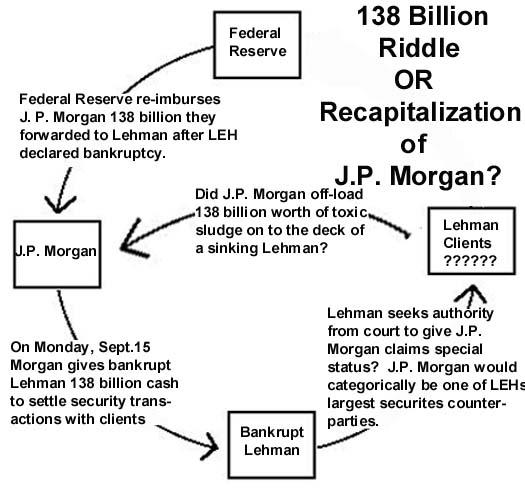
Since the Federal Reserve reimbursed J.P. Morgan, presumably and ostensibly, with public monies [that taxpayers will be on the hook for] – doesn’t the public have the right to know what that 138 billion was spent on?
Investment banks are dropping like flies, owing to their involvement in credit derivatives – this is a fact.
J. P. Morgan is – HANDS DOWN – the largest derivatives player in the world with a book of 90 Trillion in notional value at March 31, 2008 – with 9% of the book composed of Credit Derivatives. That amounts to a cool 8.1 Trillion worth of Credit Derivatives. We know this from the Office of the Comptroller of the Currency’s Quarterly Derivatives Report – pg. 24
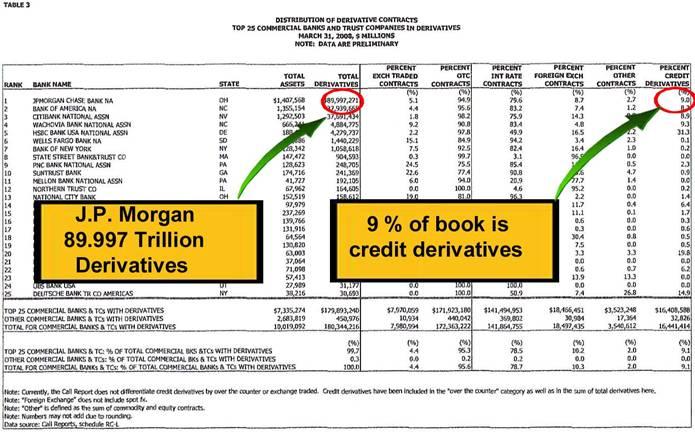
Wouldn’t you suppose that would be enough to bury any institution?
Who knows, maybe it did. We only learned about the 138 billion advance from a court document where Lehman was seeking to give claims of J.P. Morgan “special status”.
I must admit, this looks special indeed:
 |
Treachery Abounds: Setting the Record Straight
(pdf version for members)
Surveying the landscape, here’s an overview of what I’m seeing:
Decoupling Fact from Fictional Futures
In Bill Murphy’s daily commentary at LeMetropolecafe.com, Friday September 12, Murphy reported this account from one of his subscribers who happens to be in the metals recovery business:
“I have to admit Bill I have seen a lot in my time but if this information I am about to provide you doesn't prove once and for all that these markets are being totally manipulated and distorted. Then there will be nothing left to prove anymore about anything.
I have been recycling for over 10 years now and I have been focused in developing a service in the silver recovery business.
So far it's been very successful and I had been preparing an order for recovery just before they hit the silver market.
I was sitting on 29 skids @ 28,000 lbs
of fiche which equates to aprox. 385 lbs
of pure silver considering my assay on
this grade of fiche was very high.
1.4 grams per 1000 grams of micro fiche.
It's around 4 dollars per lb or 6000 ounces
of silver.
Now, I won't mention names but I was unable to setup a bullion account with this company because they don't setup accounts anymore so I can't hedge the market.
The day you deliver. You get paid spot on the Comex.
So I simply parked my product and waited. Now talk about a squeeze play. Would you believe that this company called me today [Friday] @ 10.50 silver and quoted me 16.00 per ounce with room to negotiate??? “
This account perfectly illustrates what we are witnessing, first hand; as physical stocks become more and more scarce – the Cartel is “beating the COMEX price with a stick” – making would-be-buyers think twice before putting their money down [or order in] for the real thing.
This cripples all resource companies since they ALL contract to have their off-take benchmarked against fraudulently derived paper futures prices.
This is why we currently give preference to ownership of physical metal versus mining shares.
This also provides a great backdrop for talking heads to say “commodities are toast” – lessening demand for physical or forcing liquidation through [cough] the etfs – GLD and SLV. I distrust the etfs on the basis that their alleged stocks of physical are all under the custody and direct control of institutions [the Cartel] long suspected / accused of price management of the same.
In the end, however, smart money the world over – has now cotton on to this charade. I speak quite regularly with folks around the world – there simply is NO PHYSICAL SILVER to be had – virtually anywhere.
I would like to share with you all an interaction I had with GATA’s Bill Murphy approximately 3 years ago: I remember Murphy explaining to me,
“if GATA is correct, physical metal was the Achilles Heel of the Cartel. Regarding shortages – if the GATA thesis is correct - they should categorically appear first in silver, then gold.”
So, despite the blatant pummeling of the paper commodities complex [futures], artificially lowering prices in the face of shortages WILL NOT RESOLVE CURRENT PROBLEMS, and in fact, will intensify them.
So, while these are trying times in the commodities space – they should surprise no-one.
The painful declines we are experiencing have been “linear”. The advances, I would suggest, are going to be GEOMETRIC.
When this reality sinks in universally, it will not only discredit the COMEX but all futures markets will be seen for what they are – frauds – and highly inappropriate as honest price discovery mechanisms.
The futures markets are, collectively, the basis or underpinning of the 1.25 quadrillion Derivatives Complex.
It has been the unrelenting price management of strategic commodities and distortion / falsification of economic reporting which would expose the rigging that has brought on the plethora of economic horrors which have led to the COMPLETE SYSTEMIC FINANCIAL MELTDOWN we are now just beginning to experience.
Bank of America Doing Deals That Don’t Pass the Smell Test
I’m extremely dubious of B of A’s involvement with ML, not to mention Country Wide, given their dubious involvement in such scams as BCCI [Bank of Crooks and Criminals]:
http://www.copi.com/defrauding_america/chp_23.htm
COVERUP OF THE BANK OF CROOKS AND CRIMINALS
Millions of people throughout the world lost billions of dollars, made possible by the coverup actions of people in foreign countries and in the United States. These losses would not have occurred had officials and attorneys in the United States not engaged in the crimes of coverup misprision of felonies, obstruction of justice, and had they not aided and abetted the criminal activities. Congressional committees, Justice Department personnel, the FBI, and the CIA, all knew about the corrupt operation for years.
SOURCE OF STARTUP FUNDING
BCCI commenced operations in Pakistan in 1972, with much of its funding provided by Bank of America and the CIA.(372) Bank of America claims that it sold its BCCI interest in the early 1980s, but records show that Bank of America continued to control much of BCCI's operation until shortly before BCCI was shut down. In the early 1970s CIA operative Gunther Russbacher transferred sizeable amounts of CIA funds into the bank for the start-up operations.
MADE TO ORDER FOR CIA ACTIVITIES
The CIA knew about BCCI's activities, finding this mindset suitable to its own operations. If, for argument, the CIA was not in partners with the BCCI activities, its world-wide network of operatives and assets should have discovered the BCCI activities that brought about the world's worst banking loss. BCCI was custom-made for the covert and corrupt activities of the CIA, the Mossad, drug dealers, and terrorists. My CIA contacts, including Russbacher, described how CIA operatives used the bank to launder money from CIA enterprises, including drug trafficking proceeds, money from its various financial activities within the United States, including its looting of savings and loans, to fund unlawful arms shipments, finance terrorist operations,(373) undermine foreign governments, and other covert activities.
Three years before the BCCI scandal broke, Robert Gates, Deputy Director of Intelligence Operations at the CIA, stated to another CIA official that BCCI stood for the Bank of Crooks and Criminals!
Both the Country Wide deal and the ML deal seem like “fronts” with B of A catching falling daggers in both instances paying huge premiums for major players on their way to bankruptcy in markets that are getting crushed!!
These deals have that familiar squalid Enron-esque stench emanating from them.
I would suggest that all they’ve really done is to buy a little more time – days perhaps?
B of A CEO, Ken Lewis, Openly Contradicts “Pinocchio” Paulson
Interesting thing I noticed today, when B of A CEO - Ken Lewis – appeared at a televised press conference with ML CEO – John Thain: Lewis emphatically stated that regulators had not coerced or “arranged” their shot-gun-marriage. Lewis stated that the deal was done of his and Thain’s own volition.
Fast forward a couple of hours and Pinocchio Paulson is stating how pleased he is that Fed and SEC managed to bring major market players together over the weekend.
These clowns are contradicting themselves.
Good grief, they can’t even sleaze properly.
Prepare For Energy Shortages
All the talk that Ike had not affect the energy complex in the Gulf seem to be pre-mature and no doubt played-up as cover for the “fire bombing” of the energy futures.
http://uk.reuters.com/article/governmentFilingsNews/idUKN1542617320080915
Henry Hub operator says force majeure remains
NEW YORK, Sept 15 (Reuters) - The operator of the Henry Hub, the benchmark trading point for New York Mercantile Exchange gas futures, said Monday it was assessing the status of the Hub and facilities on its mainline natural gas system, but force majeure declared over the weekend remained in effect until further notice.
In addition, Sabine Pipe Line LLC said in a website posting initial reports indicated flooding from Hurricane Ike had impacted the current operability of its system.
Sabine is the owner / operator of Henry Hub. The Henry Hub offers shippers access to pipelines that have markets in the Midwest, Northeast, Southeast and Gulf Coast regions of the United States. The Henry Hub interconnects with nine interstate and four intrastate pipelines including the following: Acadian, Columbia Gulf, Gulf South Pipeline, Bridgeline, NGPL, Sea Robin, Southern, Texas Gas, Transco, Trunkline, Jefferson Island, and Sabine's mainline. Sabine's two compressor stations at the Hub provide the operational flexibility to compress 520,000 Dt/d and make any necessary deliveries to high-pressure pipelines. Sabine currently possesses the ability to transport 1.8 Bcf/d across the Henry Hub.
The likelihood of spot energy shortages [refined product and Nat. Gas] are growing by the day.
The Dollar Rally Sham
Dr. Jim Willie recently reported that U.S. Dollar denominated bonds are likely being “called in”:
“In all likelihood the Bank For International Settlements in Basel Switzerland ordered the United States to call in USTreasurys and USAgencys, the bond instruments, the financial weapons of mass destruction. The BIS ordered the financial leadership to call their damaged risky debt securities home, so that they can explode on US soil, so that their greatest concentration rests on US soil, so that the maximum loss occurs to US institutions, so that the risk can be kept to a practical minimum for foreign nations. The benefits given to Americans are two-fold, one a bizarre paradox, the other an open door to steal.”
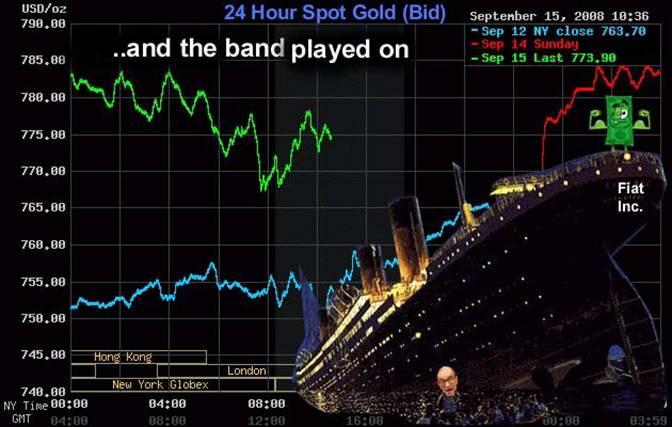
I concur with Dr. Willie assessment. It stands out in my mind that this past weekend’s Wall Street restructuring involved ZERO FOREIGN PARTICIPATION. Barclays, who had been rumored to be in the mix to save Lehman walked away from the table. Korean money, earlier last week, did the same thing.
|
To: Ontario Securities Commission
20 Queen Street West, Suite 1903
Toronto, ON M5H 3S8
Attn: PUBLIC INQUIRIES AND INVESTOR COMPLAINTS
Dear Sir or Madame;
My name is Rob Kirby, proprietor of Kirbyanalytics.com. I would like to know if the Ontario Securities Commission has any public comment regarding the public utterances for Don Coxe of the Bank of Montreal’s Harris Bank unit in his weekly web cast, for institutional clients of the bank, dated Sept. 5, 2008.
In case you have not heard or seen Mr. Coxe’s comments, the title of his presentation was:
“And Hank And Ben Looked At Their Handiwork And They Were Glad.”
He goes on to state,
[more.....signup] [open pdf....members]
UPDATE:
Follow Up To Rob Kirby Enquiry to OSC
Re: PUBLIC INQUIRIES AND INVESTOR COMPLAINTS - Ontario Securities Commission
Mr. Jeff Fennell;
Thank you for your prompt response to my enquiry and concern. I take issue with some of your comments.
Both Mr. Heinzl and I are commentators on financial markets.
Mr. Coxe is an acknowledged and pedigreed, senior officer with the Bank of Montreal – one of Canada’s largest banks. He is further the name sponsor [via BMO] of a “so named commodity fund” listed on the Toronto Stock Exchange.
[more.....signup] [open pdf....members] |
The Stars Are Aligning – But For What?
(pdf version for members)
Fannie and Freddie were finally nationalized on Sunday, September 7, 2008 – a date that may very well live in infamy. Shareholders of the mortgage behemoth mortgage giants have been effectively wiped out.
By Glenn Somerville and Mark Felsenthal
WASHINGTON (Reuters) - The U.S. government on Sunday seized control of mortgage finance companies Fannie Mae and Freddie Mac in an aggressive move to help the distressed U.S. housing market and economy.
Officials were concerned mounting losses at the two companies, which own or guarantee almost half of the country's $12 trillion in outstanding home mortgage debt, was sapping their vitality and threatening to undermine them at a time other sources of housing finance have largely run dry.
"Our economy and our markets will not recover until the bulk of this housing correction is behind us," Treasury Secretary Henry Paulson said at a news conference. "Fannie Mae and Freddie Mac are critical to turning the corner on housing.”
The decision to take control of the companies, which have $1.6 trillion in debt outstanding, and place them into a conservatorship under their regulator could amount to the largest financial bailout in U.S. history. The Treasury Department, which is taking an equity stake in the two firms, said there was no reason to expect that taxpayers would have to shoulder losses.
Folks should appreciate and understand that the Fannie / Freddie bailout are being conducted with the resources of the U.S. Treasury and not the Federal Reserve. The Federal Reserve’s balance sheet simply would not allow it.
Ladies and gentlemen, I would contend that the U.S. Treasury’s balance sheet cannot either.
The Back Drop For Context
In what many folks might disregard as an unimportant revelation, the Bank of Montreal’s Don Coxe provided in his weekly web-cast, to the bank’s institutional and private banking clients, a telling descriptive [transcript available here] of recent market events where he lays out how the Federal Reserve and the U.S. Treasury in conjunction with the CFTC and SEC “RIGGED” the recent collapse in commodities complex and the accompanying bounce in financials to purposely destroy people who were making commodity bets and shorting financials.
Coxe’s presentation is titled,
“And Hank And Ben Looked At Their Handiwork And They Were Glad.”
He goes on to state,
“So, let’s talk about this, what they did, why they did it and how brilliantly they did it, because this is the most massive intervention of government into the capital markets or the financial system since Roosevelt closed the banks back in 1933, briefly.”
Coxe goes on to explain,
“So what they did – and this is why you want in a crisis like this, you want a Goldman Sachs ex-CEO at work. People sometimes sneer about the fact that Goldman seems to just get all these big appointments. But what it means is you’ve not only got somebody that really knows the markets, but somebody who’s access to information is terrific and who really understands how you can intervene in the markets successfully. Because if you’re going to do a strategy like this, it’s got to work.”
The unintended beauty [sic] of Cox’s words is that they “drip” with nuance illustrating the incestuous relationship between the Federal Reserve / Treasury and one of their favorite private sector agent / provocateurs - Goldman Sachs.
This space has extensively documented the role of both Goldman Sachs [primarily in the investment banking / commodities space] and J.P. Morgan Chase [primarily in the commercial banking / interest rate complex] and their use as “TOOLS” to implement Federal Reserve Monetary Policy via stealth – all the while trying to maintain the illusion of “free markets”.
If my read on these goings-on is only half correct, this grand stage illusion of a charade is about to come to an end.
Our capital markets have been grossly manipulated and rigged. Regulators have been complicit. For those of you who have no problem with this, I would now like you to consider existing U.S. anti-trust laws:
The Sherman Antitrust Act is a Federal law prohibiting any contract, trust, or conspiracy in restraint of interstate or foreign trade.
The Sherman Act also provides that no person shall monopolize, attempt to monopolize or conspire with another to monopolize interstate or foreign trade or commerce.
A felony, an individual violating these laws may be jailed for up to three years and fined up to $350,000 per violation. Corporations may be fined up to $10 million per violation.
The Clayton Act regulates general practices that potentially may be detrimental to fair competition. Some of these general practices regulated by the Clayton Act are: price discrimination; exclusive dealing contracts, tying agreements, or requirement contracts; mergers and acquisitions; and interlocking directorates.
To imagine: I was always taught – growing up - that America was a country where the rule of law meant something.
Connecting Dots
The factual picture I’m painting here is that something egregiously, horribly wrong is occurring right now, under our collective noses, in our financial markets. I’m left with a sinking feeling that things are coming to a head, so to speak and all that’s been missing is to this picture is the exact timing of the culmination.
Speculating as to what this culminating event might be is the topic of an in-depth report for subscribers is being prepared for publication at Kirbyanalytics.com – explaining the mystifying recent dollar and bond rally, shortages of physical precious metals and the decoupling of the COMEX [futures] price of gold and price to acquire physical metal, and what to do next. The timing, however, I now believe is very closely tied to this; illustrated by the work of Adrian Douglas, GATA consultant and frequent contributor to LeMetropolecafe.com:
September 2 session on the TOCOM Goldman Sachs COVERED an absolutely stunning 1,612 short contracts AND ADDED 351 LONG CONTRACTS to bring their long position to 1,049 contracts (a 50% increase in one session!!!!) and their net short position to 2,537 contracts (a 44% reduction in one session!!!). This is a NEW RECORD LOW for their net short position but beats the previous low by 1,963 contracts! This has absolutely astonishing implications for the gold market. GS is running for the hills. Clearly the gold market is headed MUCH higher.
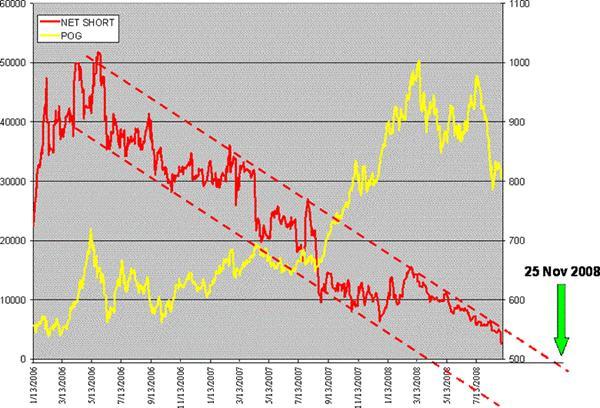
The activities of Goldman Sachs “shorting gold” on TOCOM [Tokyo Commodities Exchange] was first brought to my attention by Adrian Douglas via Bill Murphy’s daily Midas commentary at Lemetropolecafe.com. on Jan.10, 2006. Douglas has reported on Goldman’s daily TOCOM gold futures position changes for almost 3 years.
With Goldman Sachs representing a defacto surrogate of the Federal Reserve – it is clear that the Fed is moving from being “overextended short” to flat – or possibly going long gold.
I believe this transition is critically important – much like a fuse burning toward explosives.
When this position crosses over from short to long, as I expect it will sometime this month – I expect that some large deafening bells will be ringing – somewhere.
Those bells might possibly be ringing first at Fort Knox, Kentucky or West Point, N.Y., where much of the U.S. sovereign stock [8,150 metric tonnes] of gold is alleged to be stored – but has never been independently [third party] audited since the Eisenhower administration.
I hope everyone has secured their own personal cache of physical gold already.
Subscribe here |
Jim Willie, whom I speak with and exchange views with on a very regular basis, sent me the article appended below and asked me to give him my take on it in as few words as possible. My comments are in red. Thought you might all find some benefit in this.
New Credit Hurdle Looms for Banks
By CARRICK MOLLENKAMP
August 27, 2008; Page A1
U.S. and European banks, already burdened by losses and concerns about their financial health, face a new challenge: paying off hundreds of billions of dollars of debt coming due.
At issue are so-called floating-rate notes -- securities used heavily by banks in 2006 to borrow money. A big chunk of those notes, which typically mature in two years, will come due over the next year or so, at a time when banks are struggling to raise fresh funds. That's forcing banks to sell assets, compete heavily for deposits and issue expensive new debt.
[more.....signup] [open pdf....members] |
Wake-Up Call
Last week, widely regarded silver analyst, Ted Butler, reported on recent developments during the July 1 – August 5, 2008 time period in the precious metals complex [specifically, open-interest data in COMEX futures].
Butler’s work shows; As of July 1, 2008, two U.S. banks were short 6,199 contracts of COMEX silver (30,995,000 ounces). As of August 5, 2008, two U.S. banks were short 33,805 contracts of COMEX silver (169,025,000 ounces), an increase of more than five-fold. This is the largest such position by U.S. banks I can find in the data, ever. Between July 14 and August 15th, the price of COMEX silver declined from a peak high of $19.55 (basis September) to a low of $12.22 for a decline of 38%.
[more.....signup] [open pdf....members] |
M3 Reporting and the Monetary Base
(pdf version for members)
Recent research I’ve conducted and presented has led me to the inescapable conclusion that there are some SERIOUS macro incongruities in the Fixed Income [Bond] complex:
- I first broached this subject in Pirates of the Caribbean, where I dispelled the [then] popular myth that Caribbean based Hedge Funds were gobbling up unexplainable amounts of U.S. Government Debt. The reality is they couldn’t have.
- In The Elephant In the Room, presented at GATA’s Washington conference in the spring of 08, I documented how J.P. Morgan was seen to be conducting ‘massive’ trade in U.S. Government Securities that legally cannot exist.
- In Dead and Buried, But Not Forgotten, I highlighted the reporting of Daniel Gros showing, “The global financial system seems to have a black hole at its centre. Over the last two decades, US residents have sold a total of about $5,500bn worth of IOUs to foreigners, yet the officially recorded net investment position of the US has deteriorated only by a little more than half of this amount ($2,800bn). The US capital market seems to have acted like a black hole for investors from the rest of world in which $2,700bn vanished from sight - or at least from the official statistics.”
- In Dead and Buried, I then connected the dots between the possibility of securities and collateral fraud and 9-11.
The revelations in the Gros article are highly suggestive that some SERIOUS MONKEY BUSINESS has occurred with the monetary base; namely, that a stack of bonds have been/were bought [result of foreign revulsion of U.S. debt in the wake of LTCM perhaps?], or monetized if you prefer [likely through J.P. Morgan’s absurd 93 Trillion derivatives book], and the fiat money that was printed out of thin air to ‘redeem them’. These newly created balances were NEVER recorded in official statistics or M3 reporting [as the Gros article suggests] – because acknowledging their existence would be akin to admitting that foreigners had lost faith in U.S. Government Bonds.
Ladies and gentlemen, bonds DO NOT DISAPPEAR, get misplaced, or otherwise get lost in black holes - period.
This view, coincidentally, would go a long way to explaining why the Fed stopped reporting M3 Money Supply Aggregates on March 26, 2006. Could it be that the Fed was really concerned that continued reporting of M3 would have been reverse engineered by someone like John Williams revealing that bonds or debt outstanding does not equal money in circulation?
Making the amount of money in circulation look smaller – in the face of deliberate, wholesale money printing – would make fiat money appear relatively more attractive.
Who would benefit from such an act?
Published monetary aggregate data is perhaps more laughable than bogus published reports that inflation is running at 2 – 4 % levels.
For those of you naive enough to think that a Central Bank would not commit such an act, please
consider the words of Dallas Fed President Richard Fisher,
"The Federal Reserve will do what it takes to maintain its credibility, which is central to preserving the integrity of the US dollar," Dallas Federal Reserve Bank President Richard Fisher said on Tuesday.
This report, from Reuters, continues: "We seek to get it right. And the answer to your
question is we will do what gets it right," said Fisher.
Answering audience questions after a speech to the Dallas Friday Group, Fisher said the US dollar is a "faith-based currency" dependent on the credibility of a central bank.
"In addition to a faith-based currency, we are the currency of the world and we must maintain its integrity..."
Well……………..have they?
In the Fall Rollout, now posted at Kirbyanalytics.com, subscribers are reading a comprehensive 12 page report dealing with thought provoking macro analysis on geopolitical issues, pratfalls of technical analysis, derivatives, Fannie Mae and the financials as well as an updated macro analysis on the energy complex. Subscribe here.
 |
The Big Picture – August 08
The View from 30,000 Ft.
Lately, there have been many calls from monetary officials that they wish for many “walking dead’ financial institutions to ‘raise capital’ to bolster their balance sheets. With a willing and [so far] able Plunge Protection Team at the ready – some of these financings have taken place with an “air” or the appearance of success.
Others, haven't fared so well:
HBOS investors shun cashcall, $7.5 billion stock unsold
By Steve Slater
LONDON (Reuters) - An emergency fundraising by HBOS (HBOS.L: Quote, Profile, Research), Britain's biggest home lender, flopped as investors took just 8.3 percent of the shares, leaving underwriters trying to sell almost 3.8 billion pounds ($7.57 billion) of stock.
What folks should take away from this is how conflicted the “official message” of raise more capital is with financial firms’ ability to actually raise cash. As read through this report you will see just how some financials are created more equal than others.
[more.....signup] [open pdf....members] |
Making Heads or Tails of a Confused Picture
(pdf version for members)
If poor financial performance stemming from ownership of junior resource companies is getting you down – read on for some valuable insight as to remedial, insulating actions you can take now to help protect and preserve your net worth.
Understanding How and Why Metals Markets are Manipulated
The basics are these:
· A rapidly rising price of gold has historically served as the “proverbial canary in the coal mine” – alerting investors that money is being created in excess.
· This, in a nutshell, explains why gold is viewed and so widely spoken of as the “ainti-dollar”. A rapidly rising price of gold explicitly means that the purchasing power of fiat money [aka the dollar] is shrinking. As people witness, first hand, the erosion of their purchasing power – they lose confidence in the currency being debased and, they naturally seek alternatives to preserve their wealth.
· Because fiat money – backed by nothing – is, in effect, a huge exercise in blind faith - monetary authorities do go to extreme lengths to prevent the erosion or collapse of the collective faith in their brand of fraudulent currency.
· Key to their efforts – are making the historical sound alternatives look bad or worse.
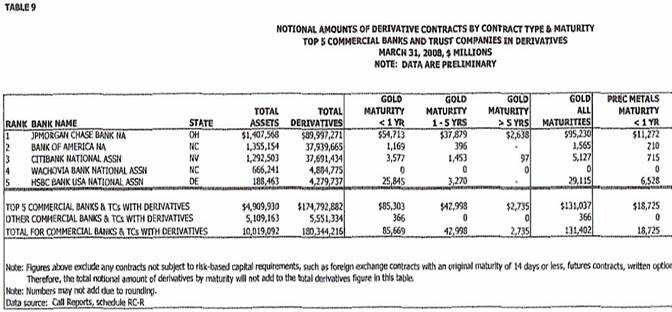
· This is accomplished by capping or even pummeling the price [primarily through the use of futures (COMEX and LBMA) through surrogate conduits utilizing their puppets in the banking community (read, Goldman Sachs and J.P. Morgan)] when metals prices start to rise in earnest. This is evidenced by the staggering amounts of gold derivatives [approx. 100 billion in notional at J.P. Morgan alone] on the books of players such as J.P. Morgan [from the Office of the Comptroller of the Currency Quarterly Derivatives Report]:
The Achilles Heel
What is vitally important for everyone to realize is that the price riggers DO HAVE AN ACHILLES HEEL. While it is not readily or implicitly apparent in the table of gold derivatives above – what folks need to understand is this: For futures markets to remain viable as price discovery mechanisms, there must be the belief [or threat if you prefer] that a maturing futures contract can, in fact, be settled with the underlying physical commodity.
This implies the following: If derivatives are, in fact, being used to suppress the price of gold then ‘some amount’ or percentage of the notional being traded - of the underlying physical commodity necessarily is changing hands.
Now, consider that we factually know that physical supply of gold [mine supply + scrap] has been in an annual deficit position, relative to physical demand [jewelry and investment] of 1,000 to 1,500 tonnes per year for as minimum of the past 10 – 15 years.
There is only one source where this undisputable deficit can be [or has been] satisfied: VAULTED SOVEREIGN STOCKS OF PHYSICAL GOLD – period!
Now, folks need to understand and appreciate that Central Banks around the world have for decades claimed to posses around 30,000 tonnes of vaulted sovereign stocks of gold bullion [including 8,000 or so tonnes allegedly held by the U.S. at Fort Knox and West Point]. Despite the facts regarding annual supply/demand deficits presented above, there has been NO ADMISSIONS to changes in the amounts of physical bullion controlled by Central Banks? They still claim to have, more or less, 30,000 or so tonnes of vaulted sovereign gold.
What we do irrefutably know about Central Banks and their accounting treatment of gold stocks would, no doubt, bring a tear to Enron’s jailed former chief financial officer – Andy Fastow’s eyes. You see, we know that Central Banks “swap” and “lease” gold. When gold bullion is swapped or leased – it physically leaves the vault and is sold into the open market. The now missing physical gold is replaced with a “paper I.O.U.” and the Central Bank continues to report [can you say double-counting?] on its books that the physical bullion is STILL THERE.
Anywhere else in the world, this would be called FRAUD.
What we can take away from all of this is the following:
· Using back of the envelope math: 1,500 tonnes x 15 years = 22,500 tonnes. Then: 30,000 [alleged vaulted] – 22,500 [accumulated deficits] = 7,500 remaining vaulted tonnes.
· The 7,500 remaining vaulted tonnes may in fact be conservative.
When this relative pittance of physical gold bullion is either gone or withdrawn from possible sale – the only possible means for price manipulation will be naked selling of COMEX futures. This leg of the ongoing price manipulation would logically and likely be savage in nature – perhaps trying to inject such extreme volatility to the metals complex that folks are literally too scared to participate.
This continued fraud WILL CAGEGORICALLY HAVE A VERY SHORT SHELF LIFE – because there will be no viable physical settlement capability/mechanism to validate the futures exchange as reliable or honest price discovery. When it ends, the price of gold and precious metals will advance geometrically.
If this assessment is correct, then one would logically be led to the conclusion that shortages of physical metal should be appearing. Low and behold, this is EXACTLY WHAT IS HAPPENING:
 |
Silver & Gold Shortage Announcement
Due to the recent price fluctuations, APMEX is experiencing a temporary shortage on certain popular products.
We are actively scouring our sources to locate additional inventory to satisfy the needs of our valued customers
Other firms, like Kitco, are a little more cunning in the way they convey the same message: |
 |
| “IMPORTANT:Due to the volatility of the market, we are experiencing a significant increase in the volume of shipments going out. Although Kitco and our depositories are working hard to stay on top of this, you may experience a delay in your order being processed by our vault, and sent out to you. We apologize for any inconvenience this may cause, and appreciate your patience and understanding.” |
And,
*Palladium Maple 1 oz (Currently out of Stock) |
$354.00 |
So, the banner headline, at a minimum, explicitly states that demand for physical bullion is exploding and provides “cover” for shortages of any metal. Furthermore, individual products cannot be supplied but the vendor has the balls to say what they would sell them for “if they had them”.
So, please…..I’d like EVERYONE to ask themselves why the price of COMEX gold futures are really collapsing?
Everyone would do well to remember that the precious metals exchange traded funds, GLD and SLV – that claim to have real bullion backing them, with custodial arrangements that are as clear as mud - were brought to market by the same folks who own the vast majority of the open interest on the “suppressive” metals futures exchanges.
Hmmm………
This sordid game is VERY LONG in the tooth. Anecdotal accounts of physical shortages of precious metal are cropping up all over the world with increasing regularity. If you haven’t yet invested a portion of your investable assets in physical bullion – time is of the essence NOW!
The August Big Picture at Kirbyanalytics.com gives subscribers more high level macro-economic analysis, making sense of conflicted financial news reporting as well as valuable insight and knowledge as to how to go about acquiring physical precious metals. |
Dead and Buried, But Not Forgotten
(pdf version for members)
Last August the 18th – 2007, a Saturday, Catherine Austin Fitts was interviewed on COAST TO COAST AM by Ian Punnett. The subject matter was the US Tapeworm Economy & Black Budgets.
During the interview, Fitts recounted a meeting she chaired back in the late 1990’s [April of 1997]. The meeting was an advisory board meeting [for pension fund managers] sponsored by a subsidiary of her [then] company, Hamilton Securities Group. In broad terms, Fitts was lecturing the attendees as to actionable steps that might be taken to help restore financial responsibility and integrity to the financial system.
In response, Fitts revealed that a senior manager from CalPERS [California Public Employees Pension] responded to her that,
“Don’t you realize……It’s too late……..They’ve [who ever “they” are] already given up on America!” They’re moving all the money off-shore [presumably to Asia]”.
Rob Kirby was so curious just who this individual was – the dude from CalPERS who claimed to posses this knowledge – that he contacted Catherine Austin Fitts directly and asked just who this individual was?
Fitts revealed to him in writing that this “fine gentleman” was none other than Bill Crist – then president of CalPERS. In Fitts’ own words,
“In April 1997, we had an advisory board meeting at Safeguard Scientifics where the board chair led a venture capital effort. I gave a presentation on the extraordinary waste in the federal budget. As an example, we demonstrated why we estimated that the prior year’s federal investment in the Philadelphia, Pennsylvania area had a negative return on investment. It was, however, possible to finance places with private equity and then reengineer the government investment to a positive return and, as a result, generate significant capital gains. Hence, it was possible to use U.S. pension funds to increase retirees’ retirement security significantly by investing in American communities, small business and farms — all in a manner that would reduce debt and improve skills and job creation. This was important as one of the chief financial concerns in America at that time was ensuring that our retirement plans performed financially to a standard that would meet the needs of beneficiaries and retirees. It was also critical to reduce debt and create new jobs as we continued to move manufacturing and other employment abroad. If not, we would be using our workforce’s retirement savings to finance moving their jobs and their children’s jobs abroad.
The response from the pension fund investors was quite positive until the President of the CalPers pension fund — the largest in the country — said, “You don’t understand. It’s too late. They have given up on the country. They are moving all the money out in the fall (of 1997). They are moving it to Asia.” He did not say who “they” were but did indicate that it was urgent that I see Nick Brady — as if our data that indicated that there was hope for the country might make a difference. I thought at the time that he meant that the pension funds and other institutional investors would be shifting a much higher portion of their investment portfolios to emerging markets. I was naive. He was referring to something much more significant.
Additionally………………..
In June 2001 the Senate Governmental Affairs Committee, under the leadership of Senator Fred Thompson (R-TN), published its study, "Government at the Brink." [1] The study describes the failure of federal government agencies to maintain reliable financial systems and/or to publish required independent annual audited financial statements. The President's initial 2002 budget (before increases for 9-11) proposed that approximately 85% of all federal appropriations be awarded to the very same agencies the Thompson study states either (a) fail to maintain reliable financial systems, (b) fail to publish trustworthy or, in some cases, any, independent certified financial statements (as required by law), or both. [2]
Reports from sources like agency inspectors general and government whistleblowers charge that the problems are much deeper than mere accounting: they allege stolen and missing inventory (planes, tanks, etc.) and in some cases actually admit that they rely on black budget funding (i.e., funding that is "off balance sheet" and not subject to Congressional oversight). The existence of such reports requires that we ask whether the very government officials and contractors who are paid handsomely to protect and manage our resources in accordance with the law are looting the federal government.
Taken together, this insight suggests that “someone” or some group is in possession of a vast sum of [illicit “off balance sheet” perhaps?] money – so large, if moved, to do serious damage to the U.S. economy – according to someone [Bill Christ] highly qualified to have an opinion on such matters.
Catherine Fitts – a true American National Treasure of under appreciated and under recognized brilliance – caught on to “the game” of how this is done early on. Her background, which gave her the unique perspective and qualifications to understand all this, includes:
- Investment Advisor: Founder and managing member of Solari Investment Advisory Services, LLC.
- Entrepreneur: President of The Hamilton Securities Group, investment bank and financial software developer.
- Government Official: Assistant Secretary of Housing - Federal Housing Commissioner, Bush I.
- Investment Banker: Managing Director and member of the board of Wall Street firm Dillon Read & Co. Inc.
Catherine has designed and closed over $25 billion of transactions and investments to-date and has led portfolio strategy for $300 billion of financial assets and liabilities.
Catherine's experiences on Wall Street and in Wasington D.C. are chronicled in Dillon Read and the Aristocracy of Stock Profits:
"Long ago, I made a promise that I would never act against the best interests or the excellence of my own people—that I would do my best to ensure that we were worthy of the stewardship of our world and that we did our best to leave a better world for generations yet to come. To make and keep such a promise is to understand that money and position are tools, not goals, and that death is not the worst thing that can happen. Some would probably accuse me of 'fighting the tape' and not being 'good at the game.' I would tell those people that now is not the time in the history of our people for a failure of imagination."
So Where Do Vast Amounts of Illicit Money Come From?
From her investment banker’s perch with experience in both Wall Street and cleaning up mortgage fraud in Washington, Fitts realized that illegal proceeds from crime were regularly being “laundered” through Wall Street conduits.
Folks need to realize that the Federal Reserve collects and analyzes data on all macro monetary flows. What this means is this: the Federal Reserve would categorically be required to be a willing participant, or willfully negligent, if any extra-ordinarily large flows of illicit fiat money were moving through “THEIR” system without them blowing the whistle, so to speak. We know this to be fact if we are going to accept the position put forward by officialdom - that they can and did accurately ‘track’ the financial trail of minute cash advances and purchases of alleged plane hijackers, in the amounts of hundreds or thousands. Are we to believe that this can be accomplished but they are UNABLE to give us the real deal on proceeds of crime – flowing through their system - in the amounts of billions and / or Trillions? From official gov't reports:
In addition to staging actual terrorist attacks in partnership with al Qaeda, Hambali and JI assisted al Qaeda operatives passing through Kuala Lumpur. One important occasion was in December 1999-January 2000. Hambali accommodated KSM's requests to help several veterans whom KSM had just finished training in Karachi. They included Tawfiq bin Attash, also known as Khallad, who later would help bomb the USS Cole, and future 9/11 hijackers Nawaf al Hazmi and Khalid al Mihdhar. Hambali arranged lodging for them and helped them purchase airline tickets for their onward travel. Later that year, Hambali and his crew would provide accommodations and other assistance (including information on flight schools and help in acquiring ammonium nitrate) for Zacarias Moussaoui, an al Qaeda operative sent to Malaysia by Atef and KSM.25
Note the intimate detail of who exactly aid for what and when they paid for it on multiple transactions in obscure locations at obscure times!!!!!
In her book, Dillon Read and the Aristocracy of Stock Profits, Fitts chronicles a gamut of unsavory financial dealings - most dealing with the lobbying for and cleansing of globally generated narco-Dollars:
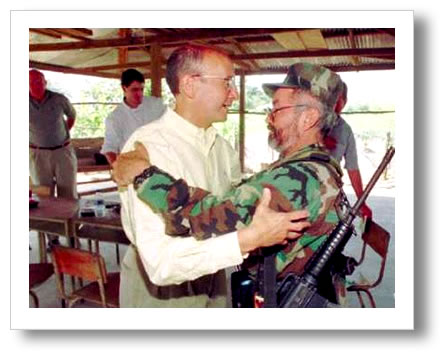
People widely regarded and understood as reputable do engage in reprehensible activities. Richard Grasso [former NYSE Chairman] hugging a FARC Commander in 1999 in a rebel village in Colombia at the time the GAO reported that FARC had assumed control of a majority market share of the Colombian cocaine trade. (Photo courtesy LaRouche Campaign)
But it was from Fitts’ time in government where she really gained a better understanding as to the level or degree of corruption and abuse of power:
As Assistant Secretary for Housing-Federal Housing Commissioner, [she] was responsible for the operations of the Federal Housing Administration (FHA), which was the largest mortgage insurance fund in the world. FHA at that time had annual originations of $50-100 billion of mortgage insurance and an outstanding portfolio of $320 billion of mortgage insurance, mortgages and properties. Leading the FHA necessitated significant understanding of how homes are built, how mortgages finance thousands of communities throughout America and how investors finance the process by buying securities in pools of mortgages. [Her] responsibilities included the production and management of assisted private housing; management of an organization of 7,000 employees in 80 offices nationwide; and development of network information systems and tools. In addition, [she] served as advisor to the Secretary of HUD on financial markets regulatory responsibilities, including the RTC Oversight Board, Federal Housing Finance Board and Home Loan Bank Board System, Fannie Mae and Freddie Mac.
When [she] told Nick Brady in 1989 that [she] was going to work at HUD, he said, “You can’t go to HUD — HUD is a sewer.” While [her] experience as Assistant Secretary cleaning up significant mortgage fraud that lost the government billions during the 1980s confirmed that HUD’s financial reputation was deserved, leading the FHA provided invaluable insight into how government management of the economy one neighborhood at a time really harms communities.
The lewd dealings that Fitts uncovered during her time in government, and later as a principal of Hamilton Securities; they centered on the fraudulent and overt abuse of mortgage bonds along with the sovereign credit of the U.S.A. Due to the dollar volumes involved – she eventually realized were operationally funding “black budgets”.
What wasn’t readily apparent to Fitts was how deep the rot was. As Assistant Secretary for Housing-Federal Housing Commissioner she had been ordered to clean this mess up and institute structural reforms so that such fraud could not happen again. It was not until after leaving government and starting her own securities firm [Hamilton] and becoming a government contractor that her life was “made a living hell”, spending thirteen years and six million dollars litigating successfully with the Federal Government who tried to refuse to pay their bills using bogus investigations as a pretext.
From all of this, one might be led to the conclusion that there are and were folks in very high places that did not appreciate successful efforts to help ensure that the Federal Mortgage Programs were run legally.
Clean operations stood in the way of a new housing bubble.
It was Fitts’ revelations and commentary regarding corruption and abuse in fixed income [mortgage bond] arena that drew the attention of Kirby’s research and interest. This was a natural since Kirby spent roughly 15 years of his working life employed in institutional sales as a money market, interest rate derivatives and bond broker. Prior to his becoming aware of her work in this area, his own proprietary forensic macro-economic research was much more focused toward irregularities and document-able Central Bank malfeasance in the global gold market.
Their two paths crossed naturally, partly due to his own brand of macro-economic research and also due to her serving as a director of GATA [short for Gold Anti-Trust Action Committee] – chaired by William [Bill] Murphy.
With sub-prime mortgages being “font and centre” in the news lately, it was no wonder that Ms. Fitts recently penned this short quip which was published at www.Lemetrolpolecafe.com:
Mortgage Market Musing
Catherine Austin Fitts
Sometimes, it helps to step back and see the big picture.
Let’s say that I serve as the depository for a large government and I also own the central bank. I get my partners appointed to run the government’s treasury and key funds on a regular basis so I can also control financial system policies and regulation that help me finance what I want to do and mess up my competitors. Even that is getting cumbersome so I am arranging to move most of the regulatory control over to my central bank because I can control all of it privately.
Frustrated with having to deal with democratic processes, I decide to move a significant amount of money out of the government between 1997 and 2001 for reinvestment abroad. I and my partners and our syndicates engineer a series of steps to bubble the economy so that when I move the money out the currency is high and because everyone was making money they did not notice that lots of capital was leaving. To ensure no one notices, I suppress the gold price which turns off the financial burglar alarm and shifts gold out of the government into my private control at below market prices.
Normally moving money out of a government in excess of the total taxes that year would be hard to do. However, I could use securities fraud. I could issue a lot more government securities and government agency (like mortgage agencies) securities than I recorded on the government books and sell them abroad. I would have to make sure not to publish audited financial statements as that would increase the liabilities of engaging in this kind of fraud. It would help a lot if I could pool mortgages and sell government agency securities to finance those mortgages in a process where the same mortgage could be sold many times into the same pool. Investors would not notice or care because the securities were government guaranteed.
I also engineer an internet and telecom stock bubble, and move trillions more out through that mechanism.
OK, so as I move the money out of the country at a high price because my currency is high, what do I invest? Well if places like Asia, Latin America and Russia experience economic crashes as a result of credit crunches that result as my cutting off credit, then their currencies will be low and they will welcome investment. Or if they don’t welcome investment, I can make sure that the IMF and World Bank can strong arm.
So I can buy in really, really cheap. Meantime, these currencies rise as I move manufacturing and jobs into the places where I now have big investment positions. So my investments go up.
Well, back in the U.S. the bubble bursts, and the institutions like Fannie and Freddie that financed the housing bubble experience significant losses. Their stocks drop by a lot. That hits the pension funds, 401ks, IRAs and other savings of the people who have lost money on their homes. It’s a double whammy. A lot of them also lose their jobs. Triple whammy.
The currency drops in value a lot. This means that the dollar I pulled out and put into other currency that has been going up, up, up, is now worth multiple dollars. As asset values drop, each remaining dollar can buy things cheaply.
Indeed, with Fannie and Freddie’s stock dropping like a stone, I could have one or more of my offshore investment vehicles fund a recapitalization plan and buy control of the senior positions directly or indirectly controlling 50% of the residential mortgages in the country with my profits — that is for a small portion of that which I shifted out of the government.
Think of it. The housing bubble has reached its logical conclusion. If you can get enough people to buy a home for no money down, you can buy their country for no money down.
Over the course of the past couple of years, a background as an interest rate derivatives [swaps] broker along with the mushrooming size of J.P. Morgan Chase’s derivatives book [high-water mark, so far, of 92+ Trillion in notional at Q3/07] – the lion’s share of it being interest rate swaps – both alarmed and garnered Kirby’s attention.
In this regard, what folks need to understand is that “if hedged” – interest rate swaps of duration between 3 and 10 years virtually always have a government bond trade imbedded in them. This raised the specter of whether or not J.P. Morgan’s 80 or so Trillion worth of Interest Rate Swaps are “hedged” or whether the institution is taking a “naked punt” of staggering proportions. The conclusion he reached after researching the topic – J.P. Morgan, through regular daily activity in their swap book, is engaged in the on-going trade of government bonds that CANNOT LOGICALLY or LEGALLY EXIST.
Rob Kirby formally presented his findings in this regard in a paper delivered at GATA’s Washington conference in April of 2008, titled, The Elephant In the Room.
Naked Short Sales [or Monetization] – More Flavors Than Ben and Jerry’s
In the mainstream financial press, of late, there has been much-ado about NAKED SHORT SALES of equities [stocks]. That these phantom stock trades do in fact occur cannot be refuted. The Securities and Exchange Commission [SEC] has not only acknowledged that these fraudulent trades do occur, although illegal, but they have even gone so far as to announce that they will be vigilant – going forward – to ensure these illegal trades do not happen to selective financial stocks.
What this shows is that regulators – in this case the SEC – do, at least on occasions - turn a blind eye to illegal actions right under their noses and certainly within their jurisdictions.
What impressed Kirby about naked short sales of equities was how similar in appearance they were with the purchase and sales of bonds – particularly in the case of J.P. Morgan Chase – that, likewise, cannot legally exist.
In the case of “phantom” stocks, laymen cannot tell the difference between real ones or the fakes. The only folks who do know the difference are the settlement agents – the DTCC [Depository Trust Clearing Corporation] – whose leadership is made up of the very firms [banks and investment firms] who perpetrate these crimes. To date, neither the DTCC nor the SEC have shown any willingness to expose the firms who have participated in these activities – citing bogus reasons of not wanting to reveal trade secrets. For all intent and purpose, the trade data is buried and will never see the light-of-day.
Folks would do well to remember the most predominant character trait of international bankers; namely, they’ve never paid allegiance to ANY nation and their conduct is best described as supra-national. History proves this point:
During the Civil War (from 1861-1865), President Lincoln needed money to finance the War from the North. The Bankers were going to charge him 24% to 36% interest. Lincoln was horrified and went away greatly distressed, for he was a man of principle and would not think of plunging his beloved country into a debt that the country would find impossible to pay back.
Eventually President Lincoln was advised to get Congress to pass a law authorizing the printing of full legal tender Treasury notes to pay for the War effort. Lincoln recognized the great benefits of this issue. At one point hi wrote:
"... (we) gave the people of this Republic the greatest blessing they have ever had - their own paper money to pay their own debts..."
The Treasury notes were printed with green ink on the back, so the people called them "Greenbacks".
Lincoln printed 400 million dollars worth of Greenbacks (the exact amount being $449,338,902), money that he delegated to be created, a debt-free and interest-free money to finance the War. It served as legal tender for all debts, public and private. He printed it, paid it to the soldiers, to the U.S. Civil Service employees, and bought supplies for war.
Shortly after that happened, "The London Times" printed the following:
"if that mischievous financial policy, which had its origin in the North American Republic, should become indurated down to a fixture, then that Government will furnish its own money without cost. It will pay off debts and be without a debt. It will have all the money necessary to carry on its commerce. It will become prosperous beyond precedent in th history of the civilized governments of the world. The brains and the wealth of all countries will go to North America. That government must be destroyed, or it will destroy every monarchy on the globe."
The Bankers obviously understood. The only thing, I repeat, the only thing that is a threat to their power is sovereign governments printing interest-free and debt-free paper money. They know it would break the power of the international Bankers.
After this was published in "The London Times", the British Government, which was controlled by the London and other European Bankers, moved to support the Confederate South, hoping to defeat Lincoln and the Union, and destroy this government which they said had to be destroyed.
They were stopped by two things.
First, Lincoln knew the British people, and he knew that Britain would not support slavery, so hi issued the Emancipation Proclamation, which declared that slavery in the United States was abolished. At this point, the London Bankers could not openly support the Confederacy because the British people simply would not stand for their country supporting slavery.
Second, the Czar of Russia sent a portion of the Russian navy to the United States with orders that its admiral would operate under the command of Abraham Lincoln. [The Czarist regime would pay dearly for this transgression in the future.] These ships of the Russian navy then became a threat to the ships of the British navy which had intended to break the blockade and help the South.
The North won the War, and the Union was preserved. America remained as one nation.
Of course, the Bankers were not going to give in that easy, for they were determined to put an end to Lincoln's interest-free, debt-free Greenbacks. He was assassinated by an agent of the Bankers shortly after the War ended.
Thereafter, Congress revoked the Greenback Law and enacted, in its place, the National Banking Act. The national banks were to be privately owned and the national bank notes they issued were to be interest-bearing. The Act also provided that the Greenbacks should be retired from circulation as soon as they came back to the Treasury in payment of taxes.
In 1972, the United States Treasury Department was asked to compute the amount of interest that would have been paid if that 400 million dollars would have been borrowed at interest instead of being issued by Abraham Lincoln. They did some computations, and a few weeks later, the United States Treasury Department said the United States Government saved 4 billion dollars in interest because Lincoln had created his own money. So you can about imagine how much the Government has paid and how much we owe solely on the basis of interest.
Selling something that does not exist [naked shorting], besides being fraudulent, is tantamount to printing money out of thin air. Most problematic for the perpetrators, perhaps, are the paper trails generated by these larcenous transactions.
With Kirby’s background having so much to do with bonds – trading and settlement – owing to the fact that he once helped set up an institutional bond-desk, Ms. Fitts’ little vignette [especially the time frame of 1997-2000 cited] really stuck in his craw.
With the events of 9/11 being forever etched in his mind – having lost so many good friends at bond broker, Cantor Fitzgerald, the world’s largest broker of U.S. Government Securities – floors 100-105 North Tower, WTC – he happens to remember intimate details of things like, the 658 Cantor employees that died that day and how quickly the firm re-commenced operations. In case none of you remember, here’s a little refresher:
Cantor Fitzgerald Finds Permanent NYC HQ, Will Add 200 Jobs
by JACK LYNE, Site Selection Executive Editor of Interactive Publishing
NEW YORK — Cantor Fitzgerald (www.cantor.com), which suffered the most devastating corporate casualties on 9/11/01, has picked a permanent new headquarters home in New York City.
….Perhaps the most critical steps in the company’s comeback came immediately after the attacks. Somewhat miraculously, Cantor and eSpeed managed to be back up and running when the New York bond market reopened at 8 on the morning of Sept. 13 — not yet 48 hours after 9/11’s attacks.
One key recovery element was the mirror site that Cantor had established at its data center in Rochelle Park, N.J. The New Jersey operation replicated all of the machines, connections and functionality inside the company’s WTC headquarters…..
…One of the biggest assists came from rival electronic trading company ICI/ADP (www.iciadp.com). While eSpeed’s IT staff was able to restore many trading system applications, it couldn’t resuscitate the system for settling transactions — which would’ve made reopening for business impossible.
Kirby wrote to Ms. Fitts after reading her Mortgage Market Musing piece,
Catherine;
Your little story posted at the cafe about a gang of scoundrels who sold bonds that might not have existed. If I was a betting man – I’d say and in fact have no doubt that those bonds were “monetized” through Cantor Fitzgerald in the time period 1997 – 2000. Trillions were undoubtedly involved.
Best,
Rob Kirby
Whether or not Trillions of dollars worth of bonds were really “monetized” through Cantor Fitzgerald form 1997 – 2000, perhaps no one will ever really know for sure.
This tidbit [or smoking gun, perhaps?] emphatically states that Trillions worth of bonds issued “disappeared into a black hole”,
Discrepancies in America's accounts hide a black hole
`By Daniel Gros
Published: June 15 2006 03:00 | Last updated: June 15 2006 03:00
The global financial system seems to have a black hole at its centre. Over the last two decades, US residents have sold a total of about $5,500bn worth of IOUs to foreigners, yet the officially recorded net investment position of the US has deteriorated only by a little more than half of this amount ($2,800bn). The US capital market seems to have acted like a black hole for investors from the rest of world in which $2,700bn vanished from sight - or at least from the official statistics.
How can $2,700bn disappear?
It is often argued that the US can simply make large capital gains on its gross positions because its assets are denominated in foreign currency and its liabilities in dollars. However, the available data indicate that over the last two decades this factor has netted the US at most $300bn-$400bn. This still leaves a loss of well over $2,000bn to be explained…..
Ladies and gentlemen, the only way that I know that 2.7 Trillion worth of bonds can disappear – is if they were “monetized” - on the sly.
If such an event did occur, the Federal Reserve would categorically and necessarily have been aware that something was amiss - if not outright complicit in the act. That, of course, would be saying something awfully nasty about the Federal Reserve [an institution that has no reserves and is no more ‘Federal’ than Federal Express] as well as the institution of “Central Banking” now – wouldn’t it? As GATA secretary and treasurer, Chris Powell, recently wrote,
Is central banking inevitably deceitful, corrupt, and grafting?
Working with GATA, you eventually discover that you're working with not just the secret knowledge of the universe -- the power of gold -- but also and just as important the largely forgotten knowledge of the ages. A powerful reminder of this can be found in an essay written five years ago for the Mises Institute in Auburn, Alabama, by one of its adjunct scholars, H.A. Scott Trask, "The Fed's Predecessors in American History."
Trask's essay is a brief history of the Second Bank of the United States, which functioned from 1817 to 1836. Trask shows how this central bank quickly resorted to market manipulation, deceit, patronage, and corruption to maintain its power and subvert democracy. Some of the methods cited by Trask are identical to those being used now by the successors of the Second Bank of the United States, the Federal Reserve and the Treasury Department.
Trask quotes the economic historian William M. Gouge as attributing the failures of the Second Bank of the United States to the very concept of central banking. "The fault is in the system," Gouge wrote. "Give the management of it to the wisest and best men in the country, and still it will produce evil."
Each day's news out of Washington and New York makes it harder to argue with those who think so.
You can find Trask's essay at the Mises Internet site here:
http://www.mises.org/story/1395
Whether or not those towers were really brought down to obscure a number of Trillions of dollars worth of illegal money creation would certainly lend credence to the 9/11 Truth Movement – who refuse to accept – as I do – the official explanation as to how and why those towers were brought down.
One can only speculate that if such a thing ever did occur – an OBSCENCE amount of money would have been created “out of thin air” which would have been more than enough to “blow a few asset bubbles with”.
Another thing, if such an event really ever did happen, the traceable records of the phony bond trades are all buried too.
All that would remain to give anyone a sniff would be unacknowledged or reported “untraceable fiat cash” – wreaking inflationary havoc on an economy somewhere.
“We shall have World Government, whether or not we like it. The only question is whether World Government will be achieved by conquest or consent.” – James Paul Warburg, whose family co-founded the Federal Reserve - while speaking before the United States Senate, February 17, 1950
Note:
Officialdom is still trying to silence the voice of Catherine Austin Fitts. Just this week she was ‘censored’ from KPFA radio in the San Francisco Bay area where Fitts had been doing a 15 minute segment once a week called "Community Business" on Flashpoints, a show on KPFA which is a Pacifica affiliate.
Fitts was offered this as an explanation, “that only academics and not for profits may be allowed on Flashpoints to cover economic issues. That means no investors, no business people including small business people or independent small investors”.
As a result, the show host, Dennis Bernstein, has requested that Project Censored investigate.
For more on Ms. Fitts' theory that covering up $4 trillion missing
from the US Treasury was an essential part of the 9-11 operations, see:
9-11 Profiteering
http://www.scoop.co.nz/stories/HL0403/S00244.htm
Will the Real Economic Hit Men Please Stand Up?
http://www.scoop.co.nz/stories/HL0503/S00090.htm
The Most Profitable Economic Hit in History
http://www.solari.com/blog/?p=978
Rob Kirby on Central Banking
http://www.financialsense.com/fsu/editorials/kirby/2006/0510.html |
China’s Coming Out Party
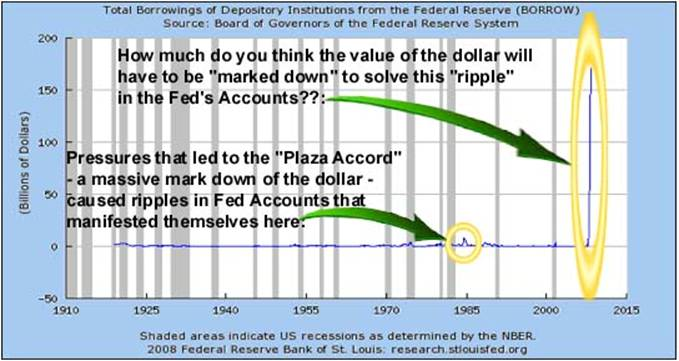
The Plaza Accord or Plaza Agreement was an agreement signed on September 22, 1985 at the Plaza Hotel in New York City by 5 nations - France, West Germany, Japan, the United States and the United Kingdom. The five agreed to, amongst others, depreciate the US dollar in relation to the Japanese yen and German Deutsche Mark by intervening in currency markets. [more.....signup] [open pdf....members] |
The Engine Room of American Monetary Policy
Who hasn’t heard of the Federal Reserve’s vaunted interest rate policy group, the FOMC? We’re all aware that this group is constituted of Fed Governors who meet every-so-often and at the conclusion of their meetings make an “announcement” regarding their target for short term interest rates or the Fed Funds Rate. Accompanying the decision on interest rates, there is typically a simultaneous release, or statement, espousing the views of the governors who make up the FOMC – which is short for Federal Open Market Committee.
It is generally accepted that the Fed then utilizes Open Market Operations, generally conducting billions in temporary [TOMO] or permanent [POMO] to direct or implement their policy decisions.
So far, so good – right? [more.....signup] [open pdf....members] |
Bootlicks For Bankers
Just this week we heard from the head of the SEC, Christopher Cox, that “naked shorting” of financial stocks would not be tolerated.
Absolutely bloody amazing!
In case anyone is unaware, naked shorting of ANY stock is basically supposed to be illegal in the first place,
Naked short selling involves selling stock without first borrowing (or
sometimes even locating) the stock. If a naked short seller does not
borrow the stock he sold, he will be unable to deliver that stock to
the buyer to close the transaction. This is called a "failure to
deliver" (FTD). Naked short selling is generally illegal, though
market makers are allowed to temporarily naked short for the sake of
bona fide market making. FTDs are always illegal when delivery failure
exceeds 13 days. [more.....signup] [open pdf....members] |
50 Ways to Leave Your GSE
First, let’s slip out the back, Jack, and try to wrap our heads around the unfolding situation. Last week, spooked investors ‘got off the bus, gus’ sending the share prices of Fannie Mae [FNM] and Freddie Mac [FRE] down more than 45 % on the week and more than 75 % on the year.
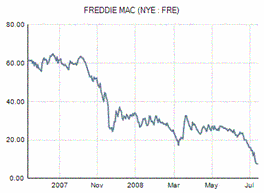 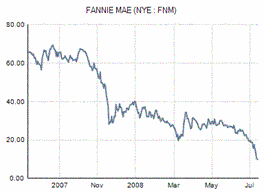
Fannie Mae and Freddy Mac play a central role in the U.S. housing finance industry because they provide a crucial source of funding for banks and other home lenders, especially since the advent of the sub-prime credit market crisis that appeared last summer.
[more.....signup] [open pdf....members] |
Chart Analysis
I’ve taken data from the latest Office of the Comptroller of the Currency – Quarterly Derivatives Report [Q1/08 just released a week ago]. I’ve done some comparisons of the same selected data Q4/07 vs. Q1/08. There are/were some interesting developments.
[more.....signup] [open pdf....members] |
Attraction Is In the Eye of the Beholder
While I will never be accused of agreeing with Professor A. Fekete on every point he makes, as a proponent of sound money, his is a voice that deserves to be heard. Thus, I was saddened to hear that Professor Fekete’s Gold Standard University Live was losing the support of its “angle investor” Eric Sprott as a source of funding:
Mr. Eric Sprott said in his letter that "we weren't attracting enough interest to justify that ongoing expenditure".
I have no idea to what extent Gold Standard University Live was being subsidized, but what I can say is this; promotion/education of the true state of our current financial system, which is seriously broken – and discussion regarding practical alternatives - is vital.
What I found particularly disturbing, was the manner in which Professor Fekete summed up the reasons for his effort’s perceived failure:
“To give you an idea of the odds I am facing let me quote from the article in Wikipedia (June 9, 2008) captioned under my name: “It should be noted that mainstream economic theorists criticize gold standard-oriented monetary economists and monetary reformers such as Professor Fekete as ‘fringe’ or ‘amateur’ economists, not worthy of serious study. Professor Fekete has never held a teaching position in the economics department of any prominent university”.
As a researcher/writer myself – one who shares many of the same core values as Professor Fekete – I’ve all-too-often heard the same commentary from ‘mainstream’ analysts and the mainstream financial press – that my work was too conspiratorial or even kooky - and only had appeal to like minded conspiracy theorists or kooks. In short, his cause is the same as mine.
Since the nature of my research is best described as both forensic and macro-economic, I can personally attest and am pleased to provide – through ‘mining’ data from my own web-log [kirbyanalytics.com] – a list of kooky institutions that have read at least one of my articles and visited my web site over a recent 3 month period. You see folks, when these entities visit my web site – they leave an electronic ‘foot print’ or their URL in my web log statistics.
[more.....signup] [open pdf....members] |
Benedict Benjamin Bernanke
Do any of you ever wonder who this guy is really working for anyway? Well, in case anyone cares, here’s what he’s supposed to be doing:

|
Mission
The Federal Reserve System is the central bank of the United States. It was founded by Congress in 1913 to provide the nation with a safer, more flexible, and more stable monetary and financial system. Over the years, its role in banking and the economy has expanded.
Today, the Federal Reserve’s duties fall into four general areas:
- conducting the nation’s monetary policy by influencing the monetary and credit conditions in the economy in pursuit of maximum employment, stable prices, and moderate long-term interest rates
- supervising and regulating banking institutions to ensure the safety and soundness of the nation’s banking and financial system and to protect the credit rights of consumers
- maintaining the stability of the financial system and containing systemic risk that may arise in financial markets
- providing financial services to depository institutions, the U.S. government, and foreign official institutions, including playing a major role in operating the nation’s payments system
|
[more.....signup] [open pdf....members] |
Something[s] That Need To Be Said
Articles like the following have begun surfacing in recent days:
RBS issues global stock and credit crash alert
By Ambrose Evans-Pritchard, International Business Editor
Last Updated: 1:23pm BST 18/06/2008
The Royal Bank of Scotland has advised clients to brace for a full-fledged crash in global stock and credit markets over the next three months as inflation paralyses the major central banks.
"A very nasty period is soon to be upon us - be prepared," said Bob Janjuah, the bank's credit strategist.
A report by the bank's research team warns that the S&P 500 index of Wall Street equities is likely to fall by more than 300 points to around 1050 by September as "all the chickens come home to roost" from the excesses of the global boom, with contagion spreading across Europe and emerging markets….
Interestingly, these dire market pronouncements coming from “establishment sources” – if we took them at face value – would be consistent with fiat cash [and bonds] being “king”. [more.....signup] [open pdf....members] |
Setting the Record Straight
Last week began, on Monday, June 9, with Lehman Brothers announcing a worse than expected 2.8 billion quarterly loss and a simultaneous announcement that they were going to raise 6 billion in new capital: [more.....signup] [open pdf....members] |
The Science of Scape-Goating
Economics is often referred to as the ‘Dismal Science’. The moniker is alleged to have originated in the nineteenth century when historian Thomas Carlyle responded to the writings of The Reverend Thomas Robert Malthus, who had grimly predicted that starvation would result as projected global population growth exceeded the rate of increase in the food supply.
For the past one hundred and fifty years, give-or-take, the mainstream has scoffed at Multhus and his dire predictions; but to be honest, I’m now wondering if he might have simply been early with his call. [more.....signup] [open pdf....members] |
Fish or Cut Bait
Last week the buzz was all about Scott McClellan’s new tell-all book, What Happened. One of the key points former Press Secretary McClellan made in his book – which is frequently mentioned on this site and in this space - was ‘the failure of the press to ask the critical questions and report accordingly’. In referencing how the Bush Administration generally viewed the press, McClellan added,
“If the press had any useful role at all, writes McClellan, it was as intermediaries in a propaganda campaign……” [more.....signup] [open pdf....members] |
In Who’s Best Interest?
Last week the Federal Reserve’s FOMC [Federal Open Market Committee] met and bestowed upon us their latest decision in monetary policy – a further cut of 25 basis points to lower the Fed Funds rate to 2 %:
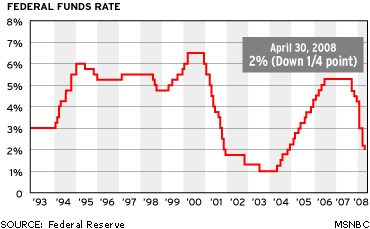
As MSNBC reported:
“The rate reduction, the third this year, was needed to energize national economic growth, Fed officials explained. The deepening housing slump is affecting the behavior of consumers and businesses alike.”
Put another way; the FED is cutting rates in hopes of spurring credit demand which in turn spurs on an up-tick in now moribund economic activity.
[more.....signup] [open pdf....members] |
Further Thoughts on Bear Stearns
A couple of interesting issues relating to Bear Stearns were raised in reader comments on John Olague's site:
First, isn’t it interesting that the New York Attorney General Elliot Spitzer, who had a history of investigating and prosecuting corporate malfeasance at the highest levels, was sand-bagged (by the FBI!) and forced to resign on 12th March.
It would have been very uncomfortable having him around during such shenanigans. Questions might have been asked, make that WOULD have been asked.
And this one I find particularly interesting:
You say that the market makers opened way OTM strikes on BSC puts. Fair enough. But do you think that the Options Market Makers were going to just take the other side of those trades without offsetting their own risk?[more.....signup] [open pdf....members] |
Still Not Your Average Prospect[s]
At PDAC 2006 I had the pleasure of meeting one of Canada’s most celebrated prospectors, Don McKinnon. With more than 45 years of experience in the international mineral exploration industry, Mr. McKinnon is renowned for the discovery of Hemlo, one of Canada's largest and richest gold mining camps. I had a lengthy chat with McKinnon and learned he had just published a book, THE SCHOLARLY PROSPECTOR, and then went on to explain what else is occupying his time these days.
Baltic Resources [TSXV: BLR]– Chaired by Canadian mining icon Don McKinnon – is one of Canada’s newer juniors, who then had 3 projects underway in Northern Ontario, Canada.
I wrote at the time, who would want to bet against Baltic’s chances for success in Northern Ontario; it’s McKinnon’s ‘own backyard’.
Baltic’s three Projects were:
Martison Lake Project
The company owns a 50% joint venture interest in a world-class phosphate deposit with a resource estimate of 113 million tonnes averaging 21% P2O5 — high-grade ore by industry standards. For 2006, the Company plans to conduct a pre-feasibility study to update the capital and operating costs, the desired product mix and operating rate of both the mine site and phosphoric acid plant. The phosphate resources will also be brought up to National Instrument 43-101 standards. Pending the results of the pre-feasibility, a bankable feasibility will be undertaken in 2007.
[more.....signup] [open pdf....members] |
A Flight to No Where
Had lunch last weekend with a friend and his wife- they’re in their 70’s but could pass for 15 years younger – a really nice couple.
He is a retired airline pilot. Used to fly 747’s inter continentally for a national airline. As an ex air force fighter pilot – he was taught about monetary economics by a co-worker back in the 70’s – just after President Nixon took the U.S. Dollar off the gold standard.
His co-worker explained to him how price inflation would categorically and necessarily ensue as a result of the revocation of gold convertibility. The advice he received at the time, in the early 70’s:
· Buy the biggest most expensive house ANYONE would finance.
· Buy GOLD
He and his wife did both – purchasing the bulk of their bullion at sub-100 dollar per ounce prices. [more.....signup] [open pdf....members] |
In Who’s Best Interest?
Last week the Federal Reserve’s FOMC [Federal Open Market Committee] met and bestowed upon us their latest decision in monetary policy – a further cut of 25 basis points to lower the Fed Funds rate to 2 %:
As MSNBC reported:
“The rate reduction, the third this year, was needed to energize national economic growth, Fed officials explained. The deepening housing slump is affecting the behavior of consumers and businesses alike.”
Put another way; the FED is cutting rates in hopes of spurring credit demand which in turn spurs on an up-tick in now moribund economic activity.
[more.....signup] [open pdf....members] |
Further Thoughts on Bear Stearns
A couple of interesting issues relating to Bear Stearns were raised in reader comments on John Olague's site:
First, isn’t it interesting that the New York Attorney General Elliot Spitzer, who had a history of investigating and prosecuting corporate malfeasance at the highest levels, was sand-bagged (by the FBI!) and forced to resign on 12th March.
It would have been very uncomfortable having him around during such shenanigans. Questions might have been asked, make that WOULD have been asked.
And this one I find particularly interesting:
You say that the market makers opened way OTM strikes on BSC puts. Fair enough. But do you think that the Options Market Makers were going to just take the other side of those trades without offsetting their own risk?[more.....signup] [open pdf....members] |
Still Not Your Average Prospect[s]
At PDAC 2006 I had the pleasure of meeting one of Canada’s most celebrated prospectors, Don McKinnon. With more than 45 years of experience in the international mineral exploration industry, Mr. McKinnon is renowned for the discovery of Hemlo, one of Canada's largest and richest gold mining camps. I had a lengthy chat with McKinnon and learned he had just published a book, THE SCHOLARLY PROSPECTOR, and then went on to explain what else is occupying his time these days.
Baltic Resources [TSXV: BLR]– Chaired by Canadian mining icon Don McKinnon – is one of Canada’s newer juniors, who then had 3 projects underway in Northern Ontario, Canada.
I wrote at the time, who would want to bet against Baltic’s chances for success in Northern Ontario; it’s McKinnon’s ‘own backyard’.
Baltic’s three Projects were:
Martison Lake Project
The company owns a 50% joint venture interest in a world-class phosphate deposit with a resource estimate of 113 million tonnes averaging 21% P2O5 — high-grade ore by industry standards. For 2006, the Company plans to conduct a pre-feasibility study to update the capital and operating costs, the desired product mix and operating rate of both the mine site and phosphoric acid plant. The phosphate resources will also be brought up to National Instrument 43-101 standards. Pending the results of the pre-feasibility, a bankable feasibility will be undertaken in 2007.
[more.....signup] [open pdf....members] |
A National Disaster
I was made aware of the existence of this article this evening. The author’s name is John Olagues. Here is his bio:

John Olagues is the owner and principal consultant for Truth IN Options and a recognized authority on listed and employee stock options.
After graduating from Tulane University (where he captained the baseball team and set many of Tulane's pitching records), John applied his B.A. in mathematics and his competitive spirit to the real world of stock options.
In 1976, John became a member of the Pacific Stock Exchange in San Francisco trading and managing options positions in scores of different stocks. John joined with Blair Hull to create Options Research, the first service to provide theoretical options values to market-makers and to the general public. In 1980, he became a member of the CBOE, where he personally traded more options in more diverse situations than any other trader.
After reading the piece, I contacted Mr. Olagues and asked for permission to repost his article with his bio. Additionally, I was curious, so I asked whether or not anyone from the mainstream financial press had contacted him regarding an interview or giving his article greater exposure?
His reply to me:
You can do with it what you wish.
I have not had any calls or emails from the main stream media as they will not criticize the FED or J.P. Morgan. I am saying the J.P. Morgan essentially stole $30 billion from the tax payers through the FED and did a big favor for the short sellers, who probably made a few billion. From Cox to Bernanke, to Dimon and Cramer, they all played their roles. [more.....signup] [open pdf....members] |
The following was prepared for GATA’s recent conference in Washington, D.C.
The Elephant In the Room
My name is Rob Kirby – proprietor of Kirbyanalytics.com, proud GATA supporter and frequent contributor to Bill Murphy’s LeMetropolecafe.com. I would like to extend a warm welcome to GATA delegates from all over the world to Washington, D.C.
I’d like to delve into the numbers, or math, showing how J.P. Morgan’s derivatives book cannot be ‘hedged’.
As per their call reports filed with the Comptroller of the Currency’s Office, we know J.P. Morgan’s derivatives book grew by a cancerous 12 Trillion from June 07 to Sept. 07. The OCC’s Quarterly Derivatives Report serves as the public’s only peek into the opaque and murky world of derivatives-flim-flammery.
Flim Flammery is the understatement of the century. In fact, dealer notionals have EXPLODED parabolic-ally in recent years while END USER demand has been static and virtually non-existent.
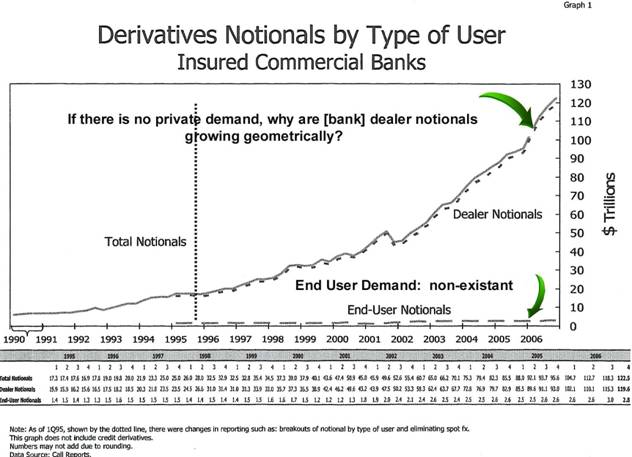
[more.....signup] [open pdf....members]
|
Getting Real
Last week saw China renew a contract with Potash Corp. of Toronto which calls for shipment of 1 million metric tons of potash at $576 per metric ton, which appears to be a $400 per metric ton increase over the 2007 price:
Chinese agree to pay extra $400 U.S. per tonne for fertilizer
Apr 17, 2008 04:30 AM
Dana Flavelle
Business Reporter
In another sign that global demand for food is going through the roof, the Chinese have agreed to pay three times as much for fertilizer this year to boost crops.
Shares in the world's largest fertilizer supplier, Potash Corp. of Saskatchewan, jumped 5.5 per cent to $198.50 a share on the news, helping take the Toronto Stock Exchange higher yesterday.
Potash Corp. is now the second largest publicly traded company in Canada, after Research In Motion and ahead of the Royal Bank of Canada and Manulife Financial, with a market value of $62 billion. Its stock has gained nearly 1,000 per cent in value over five years.
Potash Corp. announced yesterday the Chinese had agreed to pay $400 (U.S.) per tonne more for potash as supplies tightened. That's on top of the $176 they paid last year.
And there are few signs this trend is likely to reverse any time soon.
"Significantly higher potash prices and extraordinarily tight supply have become much more firmly entrenched since China's previous contract was signed 14 months ago," said Potash Corp. CEO Bill Doyle…….
Perhaps China’s willingness to pay has something to do with the dollar growth in their international reserve account: [more.....signup] [open pdf....members] |
The Inside Scoop On Libor
In the latest Office of the Comptroller of the Currency – Quarterly Derivatives Report [Q4/07], we learn that outstanding notionals for reporting banks declined by 8 Trillion. Furthermore, we are told that the overall decline was “driven by a 9.2 Trillion reduction in interest rate contracts – mostly swaps with maturities of less than one year.”
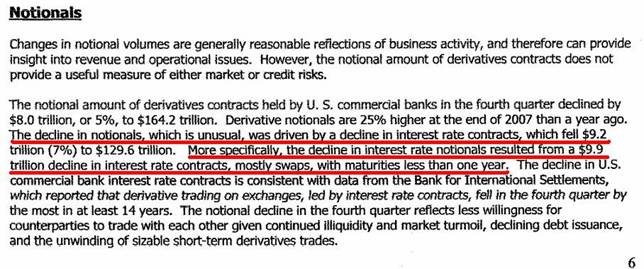
What everyone needs to understand is that short term interest rate swaps are ALL hedged against 3 month Eurodollar futures – a Libor based product. But look at what is revealed here:
[more.....signup] [open pdf....members] |
Inflation Revelations
We all read and hear from officialdom that the prospects for inflation, while elevated somewhat recently, always remain anchored and / or subdued on a forward looking basis:
….if the public experiences a spell of inflation higher than their long-run expectation, but their long-run expectation of inflation changes little as a result, then inflation expectations are well anchored. If, on the other hand, the public reacts to a short period of higher-than-expected inflation by marking up their long-run expectation considerably, then expectations are poorly anchored. ~ FED Chairman, Ben Bernanke, July 10, 2007
In this speech titled, Inflation Expectations and Inflation Forecasting, Mr. Bernanke goes on at length about the influence that ‘expectations’ have on inflation but he fails [intentionally, perhaps?] to mention its true cause:
“Inflation is a phenomenon caused by the increase of money supply relative to the growth of production capacity for goods and services.”
[more.....signup] [open pdf....members] |
Seeing the Forest Through the Trees
Eliot Spitzer is no more. While I have never been accused of being a Spitzer supporter, I do admit to being curious as to the manner in which he fell, so swiftly, from grace. As a forensic researcher – I couldn’t help but notice how well timed Mr. Spitzer’s very public demise came on the heels of his very public ‘outing’ or laying blame on the incumbent Republican Administration for the U.S.’s current financial woes:
Predatory Lenders' Partner in Crime
How the Bush Administration Stopped the States From Stepping In to Help Consumers
By Eliot Spitzer
Thursday, February 14, 2008; Page A25
Several years ago, state attorneys general and others involved in consumer protection began to notice a marked increase in a range of predatory lending practices by mortgage lenders. Some were misrepresenting the terms of loans, making loans without regard to consumers' ability to repay, making loans with deceptive "teaser" rates that later ballooned astronomically, packing loans with undisclosed charges and fees, or even paying illegal kickbacks. These and other practices, we noticed, were having a devastating effect on home buyers. In addition, the widespread nature of these practices, if left unchecked, threatened our financial markets.
Even though predatory lending was becoming a national problem, the Bush administration looked the other way and did nothing to protect American homeowners. In fact, the government chose instead to align itself with the banks that were victimizing consumers….
[more.....signup] [open pdf....members] |
Dubious Deliberations
Imagine yourself taking one of your family’s most valuable heir-looms into a professional appraiser and having them offer you an expert opinion of, say, “X”.
Believing the professional evaluator – you contract with him to sell your asset and it sells to the evaluator’s relative for 100 % of “X”.
Now imagine that the ‘same buyer’ of your asset turns around and gets a “new” professional opinion of value for your former asset – the very next week - for 5X.
Would such a bizarre scenario – if it were to actually occur – not raise some serious questions regarding motives along and cat-calls for a through investigation?
One week ago Sunday – the Federal Reserve forced Bear Stearns into a shot-gun marriage with J.P. Morgan Chase [an institution related to the Fed], whereby, J.P. Morgan Chase was to acquire Bear for $2 per share.
[more.....signup] [open pdf....members] |
The World’s Worst Kept Secret
When bond maven Bill Gross openly writes about it – as he did in his January Investment Outlook - it’s perhaps inappropriate to use the word “secret”:
Pyramids Crumbling
“But today’s banking system as pointed out in recent Investment Outlooks, has morphed into something entirely different and inherently more risky. Our modern shadow banking system craftily dodges the reserve requirements of traditional institutions and promotes a chain letter, pyramid scheme of leverage, based in many cases on no reserve cushion whatsoever. Financial derivatives of all descriptions are involved but credit default swaps (CDS) are perhaps the most egregious offenders.”
Perhaps it was a Freudian slip, Gross naming this piece Pyramids Crumbling, but he surely hits the mark – albeit from a narrow bond / credit centric point of view – that today’s financial system is an elaborate and grotesque ponzi scheme with its hallmark being the ‘crafty dodge’.
But it goes much deeper than this.
If one takes a moment to consider this from Investopedia, the Top 5 Reasons For A Stock Slide, you would see that all reasons for sharp price declines are precipitated by a “crystallizing event” with the bottom line being:
There is almost always a tangible reason behind the downward movement in a given share [or market] price after earnings are released, but it's up to the investor to play the role of detective and to try to determine what that reason is.
The Role of the Detective and Forensic Economics
When markets experience sharp or dramatic price movements – there is usually an identifiable cause or reason. Bill Gross illustrates how the bond / credit complex has denigrated into the morass of an alphabet soup of derivative defaults – all under the watchful eye of regulators and at the tacit direction of the Federal Reserve.
So, when we see market movements like this one in the silver market – with no discernable reason - that we were ‘treated to’ this morning:
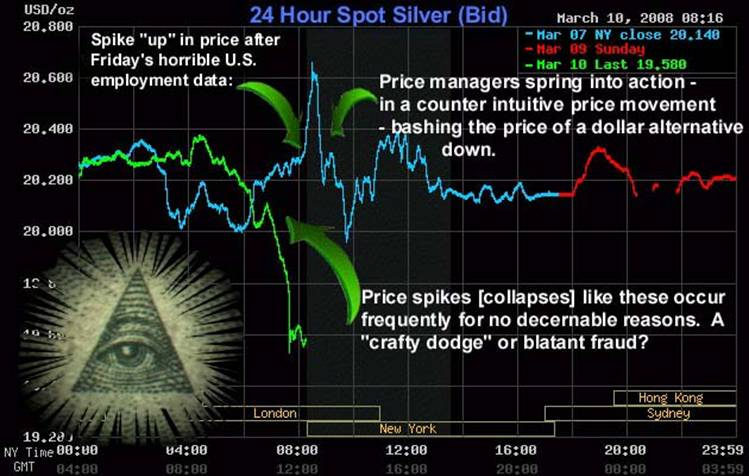
Odds are - we’ve witness been witness [or victims, perhaps?] to what Bill Gross terms “a crafty dodge” or worse.
What folks would be well advised to remember is this: market moves like the one depicted above are “paper plays” – achieved through selling futures [derivatives] in a thin market. We are given further evidence that these “paper plays” are orchestrated manipulations due to the fact that the market for ‘physical tangible silver’ remains tight and in short supply – evidenced by the stiff price premiums of physical metal over the futures price.
Price manipulations – like the one above - involving “selling down” the paper price of a commodity have historically failed when manipulators run-out-of or are unwilling to part with dwindling physical supply.
There are many who follow the metals markets closely who feel that time is now close at hand. |
Precious Power
I attended the Canada-South Africa Chamber of Business 9th Annual Mining Breakfast at this year’s PDAC seeking clarity on the extent and implications of power curtailment [brown-outs] by South Africa’s national power utility, Eskom.
South Africa's power shortages threaten growth
Gold and platinum futures hit record highs; miners' shares drop sharply
By Polya Lesova & Steve Goldstein, MarketWatch
Last update: 4:25 p.m. EST Jan. 25, 2008
NEW YORK (MarketWatch) -- Worsening electricity shortages in South Africa halted mining operations Friday, propelling gold and platinum prices to record highs and threatening to seriously dent the country's economic growth prospects…..
Mining companies are dealing with cut backs of 10% of the electricity they formerly used and I wanted to hear how this was impacting their businesses and specifically, if recent price increases in precious metals [platinum group in particular] stemming from this situation are justified and / or sustainable.
[more.....signup] [open pdf....members] |
Road Map to Successful Retail Investing
I attended the first day of the PDAC convention yesterday with a very close friend. This friend of mine was kind and sincere enough to share with me the stellar results he had achieved in his personal investment account over the past 2-1/2 years investing in a basket junior exploration and resource stocks – he had doubled his money, making multi-six figure gains, over this period of time.
These results impressed me enough that I wanted to report on how, or, better stated – what he attributed these returns to? Specifically, I wanted to know what methodology, or system, he used to select the individual investments in his portfolio.
Here’s a precis of what my close friend has to say:
To get the big picture correct he uses Kirbyanalytics proprietary macro-economic research, Lemetropolecafe’s Midas daily market commentary and then he browses and reads articles at Financial oriented web sites like Financial Sense and always listens to Jim Puplava’s weekly radio show. As a filter – for a geological perspective and to narrow down to a short list which companies he invests in, he uses analyst Lawrence Roulston’s, Resource Opportunities, a subscription news-letter.
[more.....signup] [open pdf....members] |
Academy Betrays One of Its Own
Some say love it is a river
that drowns the tender reed………..
So how does an American Patriot - a guy who won a Grammy, a Tony and an Emmy – who introduced motion picture audiences to the iconic Bette Midler producing films like ‘The Rose”, along with the unforgettable “Trading Places” starring Eddie Murphy and Dan Aykroyd - not get a mention at the Oscars – televised Feb. 24, 2008 - having passed, untimely of cancer at the age 64, on August 24, 2007?
You can’t figure it out either? Please, Tell Me More:
Some say love it is a razor
that leaves your soul to bleed….
Well, if that wasn’t enough, along the way this self-made-entrepreneur was a driving force in the music business, where he helped created and managed The Manhattan Transfer, introduced to America many legendary performers, such as Led Zeppelin, whom he brought to America for the first time.
Some say love it is a hunger
an endless aching need…….
And let’s not forget his films were nominated for six Academy Awards, as well as seven Golden Globes [winning 3].
Could it be that Aaron Russo’s name was purposely omitted from the televised list of departed luminaries because he had the guts to take on the establishment? Was he slighted because he he wrote, produced, and directed a feature film/documentary titled America: Freedom to Fascism, billed as an expose questioning the legality / constitutionality of the IRS and the Federal Reserve?
Has Hollywood finally become ‘the ministry of truth’ – a group of glamorous tools shilling for the money spinning banks? [more.....signup] [open pdf....members] |
Derelicts and Their Derivatives
Who remembers when the effects of the sub-prime contagion and subsequent freeze-up of the debt markets began to make itself visible?
For those of you who might be unaware, it was the summer of 07 – and I’d like to present this little picture of how the DOW JONES reacted to the impending financial seizures and ‘broke down’ as a little refresher:
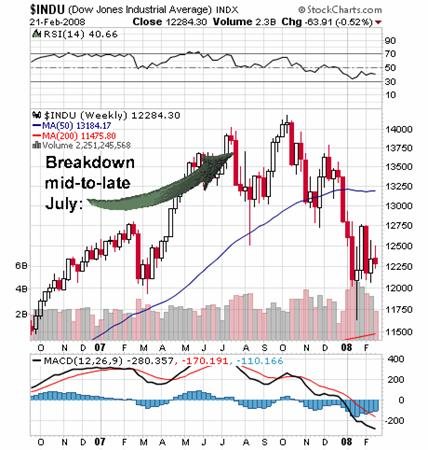
Remember any of those huge down days in July and early August last summer [07]?
I sure do. [more.....signup] [open pdf....members] |
Numbers That Do Not Add Up
Having just learned about the plans of U.S. financial elites to cease publication of another swath of economic data, producing this short report took in a timely fashion has taken on new meaning – after-all, in another month or two – the data on which it is based may have disappeared too.
The Latest Data Scheduled to Disappear Behind the Iron Curtain:
Due to budgetary constraints, the Economic Indicators service (http://www.economicindicators.gov) will be discontinued effective March 1, 2008.
Advance Monthly Sales for Retail and Food Services
Advance Report on Durable Goods
Construction Put in Place
Gross Domestic Product
Manufacturers' Shipments, Inventories, and Orders
Manufacturing and Trade: Inventories and Sales
Monthly Wholesale Trade
New Residential Construction
New Residential Sales
Personal Income and Outlays
Quarterly Financial Report
Quarterly Services
Retail E-Commerce Sales
U.S. International Trade in Goods and Services
U.S. International Transactions
A few more bones to hide in the closet, ehhh? [more.....signup] [open pdf....members] |
Getting A Handle On Inflation
Isn’t it amazing how officialdom preaches to us that inflation is under control – generally running in the 2 – 3 % range per year.
Isn’t it also amazing how the mainstream press [mostly print and television] gives unlimited amounts of face-time and exposure to a long list of ‘experts’ who espouse these views?
Equally amazing is how pundits in the contrarian’s community have painstakingly documented how the most widely reported inflation data has had systematic adjustments made to it so as to corrupt it beyond belief.
An alternative measure of inflation with a long history which is tabulated by private sources – beyond the direct influence of officialdom – is the CRB Index.
The CRB index [short for Commodities Research Bureau]. From their homepage on the web:
Since 1934, Commodity Research Bureau (CRB) has been the world's leading commodities and futures research, data, and analysis firm.
CRB delivers information on the futures markets to interested parties via a number of data products, email and print publications, fundamental services and B2B products. It also is home of the CRB Price Index, a global benchmark for measuring commodity price movement and developed by one of CRB's founders, Bill Jiler.
[more.....signup] [open pdf....members] |
An Inverted Pyramid Scheme
Last week, on Feb. 5, the Australian Central Bank raised interest rates by a quarter-point to 7.00 % in an “effort” to rein-in inflation.
Two days later, on Feb. 7, the European Central Bank [ECB] held rates steady at 4.00 % while the Bank of England [BOE] lowered interest rates by a quarter-point to 5.25 %.
Both the ECB and the BOE were reported in the mainstream financial press as ‘weighing concerns’ of inflation against those of a global economic slowdown.
These actions along with this reporting, taken together, almost makes you want to believe that interest rates are the sole determinant of inflation, eh?
Sadly – almost everyone believes this – usually because some accredited news outlet like Bloomberg or Reuters says so. Interest rates – unto themselves – have very little to do with Inflation. Money Growth – on the other hand – has everything to do with inflation. This is why the Federal Reserve canceled M3 Money Supply reporting – they quite simply do not want us to know how fast they are growing the money supply because it would make a complete mockery of their “officially published” inflation reports in the 2 – 3 % range: [more.....signup] [open pdf....members] |
Myth vs. Reality
Much was made of Iran’s announcement back in December, 2007 – that they would no longer be accepting U.S. Dollars as payment for their chief export, crude oil:
Iran stops selling oil in dollars
Tehran moves closer to confrontation with U.S.
Posted: December 8, 2007
12:46 p.m. Eastern
By Jerome R. Corsi
© 2007 WorldNetDaily.com
Iran today announced a decision to end all oil sales in dollar transactions, moving one step closer to confrontation with the United States…..
Perhaps fewer people would remember a pre-cursor to this announcement – back on July 13, 2007 – when Iran put Japan [its largest oil trading partner] on notice that they would only conduct their crude oil trade in Yen going forward:
Times Online
July 13, 2007
Iran demands oil pay in yen not dollars
The dollar fell against the yen this afternoon on reports Iran has asked Japan to stop paying for its oil in dollars
Robert Lindsay
The dollar was driven down against the Japanese yen this afternoon, hit by the news that Iran had asked Japan to pay for its oil purchases in the Japanese currency and not in dollars.
Iran has sent a letter to Japanese refiners, signed by Ali A Arshi, the general manager of crude marketing and exports for Iran's national Iranian Oil Company, according to a report by Bloomberg.
The letter asks for yen payments "for any/all of your forthcoming Iranian crude oil liftings." The request is for all shipments "effective immediately".
One might logically think this would have quite an impact on countries that buy Iran’s 2.5 million barrels per day of exported oil. [more.....signup] [open pdf....members] |
Stuff That Doesn’t Add Up
Last week global capital markets gyrated in fashion I’ve never seen before. Intra-day business-cycle-in-a-day movements in equity markets included disparaging collapses as well as stunning “flagpole” rallies.
It made for some gripping, televised, real-time, fantasy-land, main steam financial reporting.
I must admit, I became exhausted just watching / listening to it all happen.
By Thursday of last week, the mainstream financial press had “more or less” arrived at the conclusion that the wild-ride-proceedings we experienced earlier in the week was all the work of a “lone trader” - a junior employee working for French banking giant – Societe Generale:
[more.....signup] [open pdf....members] |
Reading Tea Leaves
Tomorrow, Jan. 15, 2008, the Bureau of Labor Statistics [BLS] is due to release their report for December Producer Price Inflation [PPI]. Last month at this time the BLS reported a steep rise in prices for November led by stiff increases in prices of crude oil.
As the updated chart below will attest, the energy component of Nov. PPI reported last month – as measured by the proxy West Texas Intermediate [WTI] - indeed reflects a large price increase in the Oct – Nov time frame.
When this news broke – stock markets dropped, bonds experienced a mild sell-off [temporarily higher yields] and the price of gold attempted to rally.
Seeing as we already know that the price of crude oil – as measured by WTI – decreased between Nov. and Dec. sample dates – one might surmise that the energy component of tomorrow’s PPI report will likely show a favorable [lower than expected] headline number. Expect cat-calls in the mainstream financial press that inflation is tame and under control - giving the FED more flexibility to lower rates.
[more.....signup] [open pdf....members] |
Fiction at its Finest
Today, the Bureau of Labor Statistics [BLS] released their report on December
Non Farm Payrolls:
THE EMPLOYMENT SITUATION: DECEMBER 2007
The unemployment rate rose to 5.0 percent in December, while nonfarm payroll employment
was essentially unchanged (+18,000), the Bureau of Labor Statistics of the U.S. Department
of Labor reported today. Job growth in several service-providing industries, including
professional and technical services, health care, and food services, was largely offset
by job losses in construction and manufacturing.
Average hourly earnings rose by 7 cents, or 0.4 percent.
[more.....signup] [open pdf....members] |
Invested or Induced?
Since this is New Year’s Eve, let’s all hoist one for the Oracle of Omaha – shall we? On Friday the Oracle’s Berkshire Hathaway announced it was purchasing the reinsurance unit of ING [NRG] for 435.7 million in cash and also notified the free world that it expected to be granted a license Monday [today] to open a new bond insurance business – Berkshire Hathaway Assurance Corporation.
Maybe it’s just me but doesn’t this announcement – coming on a Friday with the expected granting of a license by regulators on Monday reek of shotgun marriage?
[more.....signup] [open pdf....members] |
A Crude Conundrum
Over the past few weeks much has been written about the Bernanke led Federal Reserve and whether or not the Fed has been “ahead” of the game where monetary stimulus is concerned in an economy that is showing increasing signs of systemic stress.
I have even read articles claiming that money growth has in fact been stagnant for much of this year – from market analysts such as John Hussman - arguing that the Fed is perhaps “behind the curve” and generally only injects money into the system on a “temporary” [repo] basis:
“So it's difficult to understand why investors would get all excited about the Fed temporarily buying up a few billion in government securities, when we've got a Federal government that's simultaneously and permanently issuing and then constantly rolling over many, many times that amount. It‘s an escape into dreamland to believe that Fed actions have any chance at all of providing more “liquidity” when the Federal government's deficits suck up in a matter of weeks every bit of liquidity that the Fed has provided in a year. These Fed actions are nothing but marginal tinkering around the edges of the global financial system, and investors are starting to catch on.“ [more.....signup] [open pdf....members] |
Where the Bones Are Buried
This past weekend I was reading a snippet of the Privateer; a brilliantly prescient newsletter that was re-iterating the words of financial journalist Ambrose Evans-Pritchard in describing the unprecedented and coordinated Central Bank actions last week,
“Never before have the central banks of North America, Europe, and Britain acted together as such a unified phalanx, but never before have transatlantic credit markets seized up with such violent effect.”
The folks at the Privateer went on to add,
Behind Closed Doors – Frankfurt Expodes In Rage:
“The European Central Bank [ECB] is a full-scale participant in the desperate global attempt to get the western world’s banking and financial system restarted. In Frankfurt, the officials are seething at the enormous scale of borrowing by British banks at the European Central Bank’s window, calling much of it “central bank arbitrage”. The main British banks are doing this because it is cheaper and easier to borrow from the ECB’s window than it is for them to borrow in the London Libor market or in any other market. But in the process of borrowing from the ECB, the British banks cause the ECB to create new volumes of Euro currency vastly beyond the Eurozone’s own needs. That inflates the Euro.” [more.....signup] [open pdf....members]
|
The Invisible Hand
Today I telephoned the good folks at the Bureau of Labor Statistics in Washington, D.C. I phoned to find out a little bit more about how one of the key inputs – CRUDE OIL - in PPI [Producer Price Index] is determined each and every month.
Here’s the nuts of what I was told:
“Crude oil price data inputs for the PPI are measured from sources of the subject month on the Tuesday of the week that contains the 13th day.”
Sounds good to me. [more.....signup] [open pdf....members] |
The Best Case Yet For Gold
Despite continuing assertions from officialdom to the contrary, inflation is alive, well and unfortunately – flourishing.
Continued claims that we live in a 2 – 3 % inflationary environment fly in the face of broad money growth rates [M3] of 14 % in the U.S. and annualized growth rates in excess of 27 % in countries like Russia:
Money Supply I2 (National Definition) in 2007
(billion rubles)

|
Date |
M2 Money Supply1
end of period |
Money Supply Growth Rates, % |
Total |
Including: |
against previous month |
against 01.01.2007 |
cash (I0) |
non-cash funds |
01.01.2007 |
8,995.8 |
2,785.2 |
6,210.6 |
12.3 |
— |
01.02.2007 |
8,700.8 |
2,630.1 |
6,070.6 |
-3.3 |
-3.3 |
01.03.2007 |
8,902.0 |
2,682.0 |
6,220.1 |
2.3 |
-1.0 |
01.04.2007 |
9,412.6 |
2,741.2 |
6,671.4 |
5.7 |
4.6 |
01.05.2007 |
10,006.0 |
2,859.4 |
7,146.6 |
6.3 |
11.2 |
01.06.2007 |
10,699.3 |
2,896.6 |
7,802.6 |
6.9 |
18.9 |
01.07.2007 |
10,857.7 |
3,027.5 |
7,830.2 |
1.5 |
20.7 |
01.08.2007 |
10,923.5 |
3,087.0 |
7,836.5 |
0.6 |
21.4 |
01.09.2007 |
11,156.8 |
3,170.6 |
7,986.2 |
2.1 |
24.0 |
01.10.2007 |
11,494.0 |
3,220.9 |
8,273.2 |
3.0 |
27.8 |
01.11.2007 |
11,421.7 |
3,259.1 |
8,162.6 |
-0.6 |
27.0 |
|
1 M2 is defined as total cash in circulation (outside banks) and balances in the domestic currency on accounts of resident non-financial organizations and individuals.The methodology for calculating M2 and its structural components is detailed in the Summary Methodology (Section 1) of the "Bulletin of Banking Statistics".
And Here’s Why We All Should Care [more.....signup] [open pdf....members] |
Capitalism: Derailed, Dumbed-Down or Deceased?
When the Berlin Wall fell back in November 1989, many in the west looked upon the event as being symbolic of the triumph of Capitalism over Communism.
Remember the warm and fuzzy feeling?
Our collective attention, albeit for a brief moment, was redirected toward the great debate of how the peace dividend would be spent.
The peace dividend is a political slogan popularized by US President George H.W. Bush and UK Prime Minister Margaret Thatcher in the early 1990s, purporting to describe the economic benefit of a decrease in defense spending.
With the United States mired in conflict[s] throughout the Middle East, some of you might now be wondering if indeed there ever really was a ‘peace dividend’.
If we take a cursory look at “official government numbers” [see below], we can empirically see that YES, there has been a discernable peace dividend with the defense budget dropping from the 6 - 8 % range to the high 3 % range of GDP:
[more.....signup] [open pdf....members] |
Prescient Pronouncements
For those of you who ascribe to the notion that hindsight really is 20 / 20, I offer you these words uttered by Richard W. Fisher, Chairman and CEO of the Federal Reserve Bank of Dallas, on June 14, 2006:
“Faith is certainly the basis of your confidence in the Federal Reserve. I have spoken in previous speeches of our “faith-based currency,” a term I use only slightly tongue in cheek. The dollar—like the euro, the yen, the British pound and other currencies—is what economists call a fiat currency. It is backed only by the federal government’s power to raise the revenues needed to meet its obligations and by the rectitude of the U.S. central bank. If the market were to lose faith in either assumption, the dollar would be debased.”[more.....signup] [open pdf....members] |
Derivatives Dirigible
Last week I penned a quip highlighting data contained in the latest Quarterly Derivatives Report from the Office of the Comptroller of the Currency. Specifically, I wanted to draw attention to the new growth [10 Trillion in Q2/07] being reported in outstanding notionals in J.P. Morgan Chase's derivatives book:
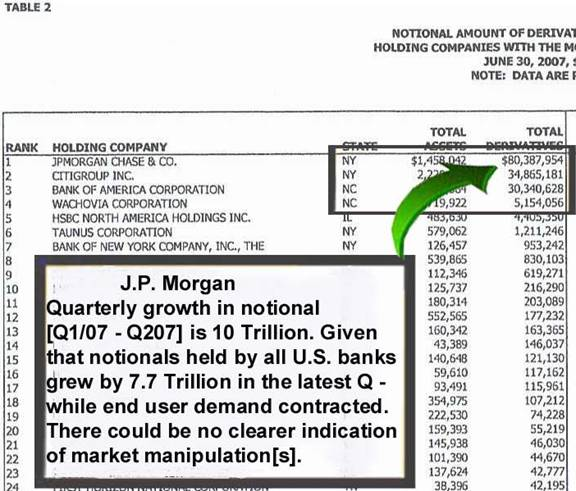
[Source: table 2 on page 23 of pdf doc – Quarterly Derivatives Report]
I was somewhat surprised by some of the comments and feedback I heard and read regarding this issue. One informed market watcher named ‘Sabre' - who happens to be a regular editorial contributor at Bill Murphy's LeMetropole Cafe - chimed in with this observation:
[more.....signup] [open pdf....members] |
HANK'S HOUSE OF HORRORS

U.S. Treasury Secretary Hank Paulson recently proposed the establishment of a $75bn-plus ‘superfund’ to buy unwanted asset backed commercial paper in hopes of accelerating the return of ‘liquidity’ to the marketplace.
Mr. Paulson’s proposal has been endorsed by financial market heavy-weights J.P. Morgan Chase, Citibank and Bank of America.
I’d like to examine how we got here in the first place.
As evidenced in the charts of U.S. money supply growth below, Central Banks around the world have been creating money at a blistering pace for better than 10 years:
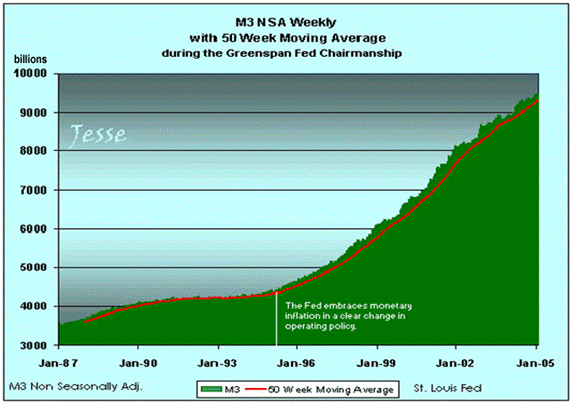
Fed Res. Chart compliments of Jesse: http://www.geocities.com/arthurcutten/jesse.html
Folks should understand that the act of printing new money dilutes the existing monetary stock.
[more.....signup] [open pdf....members] |
A National Disgrace
As a Canadian, I would first like to voice my disgust with actions taken by my fellow countrymen [Alberta’s Provincial Government] yesterday – who saw fit to ‘rewrite’ royalty agreements they had entered into with the oil industry.
A very sad day for Canada’s honor and reputation.
As disgusting as all of this is, it still pales in comparison to an even bigger, much more preposterously glaring disgrace that I’d like to draw your attention to.
A little over a year ago I penned an article titled, Everyone Loves A Parade. The article chronicled the growth of J.P. Morgan derivatives book from Q4/05 to Q1/06 of 5.5 Trillion.
Just today, the Office of the Comptroller of the Currency released their latest Qrtrly. Derivative Fact Sheet for Q2/07. In the latest reporting period [Q2/07], J.P. Morgan Chase’s derivatives book has swelled by a cool 10 Trillion in notional:[more.....signup] [open pdf....members] |
Who Bought What?
According to the U.S. Treasury – the latest TIC data [August] tells us the following:
October 16, 2007
HP-611
Treasury International Capital (TIC) Data for August
Treasury International Capital (TIC) data for August are released today and posted on the U.S. Treasury web site ( www.treas.gov/tic ). The next release, which will report on data for September, is scheduled for November 16, 2007 .
Net foreign purchases of long-term securities were minus $69.3 billion.
· Net foreign purchases of long-term U.S. securities were minus $34.9 billion. Of this, net purchases by foreign official institutions were minus $24.2 billion, and net purchases by private foreign investors were minus $10.6 billion.
· U.S. residents purchased a net $34.5 billion of long-term foreign securities.
Net foreign acquisition of long-term securities, taking into account adjustments, is estimated to have been minus $85.5 billion.
Foreign holdings of dollar-denominated short-term U.S. securities, including Treasury bills, and other custody liabilities increased $33.9 billion. Foreign holdings of Treasury bills increased $21.0 billion.
Banks' own net dollar-denominated liabilities to foreign residents decreased $111.4 billion.
Monthly net TIC flows were minus $163.0 billion. Of this, net foreign private flows were minus $141.9 billion, and net foreign official flows were minus $21.1 billion.
Who am I to argue with the U.S. Treasury? [more.....signup] [open pdf....members] |
Inconvenient Truths
I'd like to spend a few minutes on a topic that Jim Puplava frequently covers on his radio program – Peak Oil. It bears mentioning – over-and-over – because too many folks are still caught up in the notion that Peak Oil is something “we all” don't have to worry about in the here-and-now.
Nothing could be further from the truth.
Let's stop and consider just how wrong the ‘don't worry be happy crowd' have been where the current / observable oil market situation is concerned – shall we:
World Oil Prices
The world oil price cases in this report are the same as those in EIA's Annual Energy Outlook 2007. In the reference case, world oil prices decline from $68 per barrel in 2006 to $49 per barrel in 2014, then rise to $59 per barrel in 2030 ($95 per barrel on a nominal basis).
When one stops and considers that the pronouncement above was made – 5 months ago - in May of 2007 – it's hard not to wonder just how, or why, ‘experts' could be clinging to a hypothetical-reference-case so clearly, utterly and empirically WRONG.
[more.....signup] [open pdf....members] |
Derivative Applications In the Real World
Although I've written a fair amount on derivatives – it seems that quite a number of folks still aren't sure as to what's really going on. I understand that many can be easily confused by the term “derivative” – particularly owing to the fact that the term ‘derivative' can apply to everything from an exchange traded futures contract to a ‘bundled' OTC security. I received this query today from an individual who apparently works in the Treasury of a corporation. If these guys don't “get it” – you have to ask yourself who really does?
So I thought I'd share the correspondence with you all and I hope it is of use.
[more.....signup] [open pdf....members] |
The Night They Drove Ole Dixie Down
"When the music stops, in terms of liquidity, things will be complicated. But as long as the music is playing, you've got to get up and dance. We're still dancing." – Charles Prince, CEO, Citigroup
Virgil Caine was not his name
He was Sir Easy Al of Greenspan fame
And he served at the Fed Reserve.
After Y2K the markets they fell,
so he lowered rates,
it was a time I remember oh so well.
Na, na na na na na na, na na na na na na, na na na na na na
Instead of me singing my whole way through this [ although you're welcome to ], I thought I'd share a few stanzas from Robert Morley's , The Con That Turned the World Against America;
[more.....signup] [open pdf....members] |
A Short Research Note On a Material Change
For those of you who did not notice, China 's new 200 billion sovereign fund ‘officially opened for business' on Saturday, Sept. 29, 2007 .
Article here :
BEIJING : China 's sovereign wealth fund opened for business on Saturday, promising not to take excessive risks and to be sensitive to international concerns as it goes about investing $200 billion of the nation's vast reserves. The agency, called China Investment Corp Ltd (CIC), has the potential to grow into one of the world's biggest funds but faces the short-term challenge of recruiting experienced managers and earning enough on its overseas assets to offset the steady appreciation of its home currency, the yuan. “The strategy of CIC will be based on active, sound management to maximise returns for our shareholders within an acceptable bound of risk,” Lou Jiwei, a former vice finance minister who is chairman of the fund, told a ceremony…….. [more.....signup] [open pdf....members] |
The Genesis of OTC Interest Rate Derivatives
Misinformation regarding the origin and genesis of the OTC Interest Rate Derivatives complex abound in the market.
During the 1970's – after President Nixon took the world off the gold standard - the dramatic increase in the price of crude oil led to burgeoning balances of petro dollars [Euro-dollars] in the treasuries of banks involved in international trade. This immediately led to banks bolstering their treasury operations to deal with the influx of ‘inflated dollars'.
In the beginning these petro-dollar balances were strictly lent or borrowed in the inter-bank market.
Interest Rate Derivatives were initiated by the establishment [around 1980] of the four 3-month IMM Eurodollar Futures Contracts [Dec, Mar, Jun, Sept] on the Chicago Mercantile Exchange [CME]. These contracts settled against 3 month libor [London Interbank Offered Rate] for Eurodollar Time Deposits on the third Wednesday of the contract month. The 3 month libor rate is ‘set' daily by a group of banks selected by the British Bankers Association and represents where these ‘reference banks' are willing to ‘loan' their mostly recycled Euro Dollar [petro-dollar] as 3 month time deposits. [more.....signup] [open pdf....members] |
A Reversion to the Mean
How many of you have heard the saying or explanation by a technical analyst that a given market movement was nothing more than, “a reversion to the mean?”
Let's examine just what that means, shall we:
Mean reversion is a tendency for a stochastic process to remain near, or tend to return over time to a long-run average value. For example, interest rates and implied volatilities tend to exhibit mean reversion. Exchange rates and stock prices tend not to. Stock market returns, however, do tend to exhibit mean reversion. Exhibit 1 provides an intuitive illustration of the difference between mean reverting and non-mean reverting behavior.
Mean Reversion
Exhibit 1 |

|
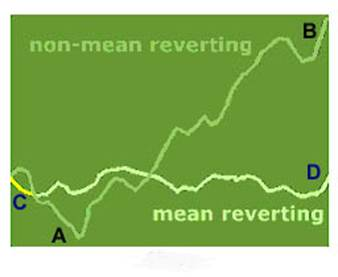
|
Mean reversion is a tendency for a stochastic process to remain near, or return over time to a long-run average. |
[more.....signup] [open pdf....members] |
Us and Them: An Interview With Catherine Austin Fitts
I want to take everyone back to Saturday, August 18 th – 2007. On this night, COAST TO COAST AM's [world's most listened to late night talk-radio show] Ian Punnett interviewed Catherine Austin Fitts . The topic for discussion that evening was the US Tapeworm Economy & Black Budgets .

Catherine Austin Fitts
Here's an overview of the interview as provided by the editorial staff of Coast To Coast AM:
In this interview ,
Fitts spoke about black budgets—money used by the federal government which is not reported in their financial statements—and how they are used to fund (on a non-transparent basis) corporations performing secret military and intelligence functions. She said the people who control these 'covert' cash flows end up manipulating the 'overt' world.
She described how money can be laundered through publicly traded companies, using the European Union's lawsuit against RJR Nabisco as a case study. Fitts explained stock 'pump and dump' schemes, pointing out that not only can stocks be pumped up and dumped but so can real estate, countries ( Iraq ), and even the planet. Fitts noted problems with the central banking warfare model, which she said helped make America successful but is not sustainable and no longer works. She also explained what she calls the 'tapeworm economy,' in which a small group of insiders centralize political and economic power to make money in a way that actually destroys wealth.
Fitts discussed the US Department of Housing and Urban Development (HUD), which she said is being run as a "criminal enterprise." According to Fitts, HUD reported $17 billion missing in fiscal 1998 as well as $59 billion in undocumented adjustments the following year. The HUD inspector general refused to produce financial statements, she said, noting that it is illegal to spend money that has not been appropriated by Congress. Fitts also talked about the last housing bubble, the current crisis in the housing and mortgage markets and how it was engineered.
But apart from the interview being, on-the-whole, both illuminating and brilliantly conducted by host Ian Punnett – I found the most relevant and telling insight that was offered in the interview to be something a little bit more obscure. This ‘diamond in the rough' required some polish – by way of a fuller explanation.
The precious insight I'm referring to is this: [more.....signup] [open pdf....members] |
Show Me the Money
The terms liquidity and liquidity add have been widely bandied about in the mainstream financial press in recent weeks. So I thought it might make a whole lot of sense to review exactly what constitutes liquidity injections.
When the Fed conducts Open Market Operations they are classified under 2 broad headings:
TOMO – Temporary Open Market Operations
These purchase and resale agreements [hence the name Repo] typically range in duration from 1 – 14 days. A One day Repo would have the Fed purchase collateral [Treasury Bond, Agency Bond or Mortgaged Backed Sec.] from the dealer's inventories TODAY [at an implied yield] and have them sell it back to them tomorrow. This provides the dealer with temporary [overnight – 14 days] cash to fund their businesses.
POMO – Permanent Open Market Operations
These are outright purchases of bills, bonds and/or notes from the dealer's inventories and constitute permanent additions to money supply.
Interested parties can actually keep track of the most recent 25 Temporary Open Market Operations from the web site of the Federal Reserve Bank of New York linked here .
Lately, the Fed has been adding via TOMO – a combination of 1 day or over-the-weekend Repos in conjunction with multi-day Repos. [more.....signup] [open pdf....members] |
Whistle While You Work
I'd like to devote today's market wrap to a review of a few interesting and illuminating developments which have occurred over the past fortnight.
First off, I'd like to shine a bit of light on this item which was published by Forbes this past Friday:
Whistleblowers on Fraud Facing Penalties
By DEBORAH HASTINGS 08.24.07, 3:16 PM ET
One after another, the men and women who have stepped forward to report corruption in the massive effort to rebuild Iraq have been vilified, fired and demoted.
Or worse.
For daring to report illegal arms sales, Navy veteran Donald Vance says he was imprisoned by the American military in a security compound outside Baghdad and subjected to harsh interrogation methods…… [more.....signup] [open pdf....members] |
Why NO – ONE Gets It
Any attempt to use conventional metrics to make heads or tails of this unfolding complete-and-utter-failure of our financial system is a waste of time.
Over the past few days, I've heard too many mainstream financial commentators trying to draw parallels between the current unfolding derivatives melt-down and the LTCM debacle of 1998.
Also, these would-be experts – their ‘professional opinions' are largely predicated on the notion that we live and are operating in a free market capitalist system.
But we are not.
The experts are having a tough go-of-it explaining, because the fundamental differences are known to so few.
What were once “free markets” are being [and have been for a long time] steered, scripted and cajoled by Central Bankers and Monetary Elites – the PLUNGE PROTECTORS - from behind a veil or black curtain.
I reader contacted me a couple of days ago asking me how I would compare the current CDO / Sub-prime situation versus the LTCM debacle back in the late 90's. This was my reply:
[more.....signup] [open pdf....members] |
Analysis of the Unfolding OTC Derivates Melt Down
In the past few weeks we've all been ‘peppered' with reports about CDO's and growing contagion associated with sub-prime mortgages.
For clarity's sake – everyone should first understand that these instruments are – for the most part – all broadly defined as OTC derivatives.
What now appears to be ‘systemic problems' in the Financial System all began with revelations by Bear Stearns.
Interestingly, in Bear Stearns latest 10-K filing with the SEC, they self-describe [at the top of page 54 if you want to play along at home] their activities conducted in off-balance-sheet-arrangements are described as follows:
In the normal course of business, the Company enters into arrangements with special purpose entities ("SPEs"), also known as variable interest entities ("VIEs"). SPEs are corporations, trusts or partnerships that are established for a limited purpose. SPEs, by their nature, are generally not controlled by their equity owners, as the establishing documents govern all material decisions. The Company's primary involvement with SPEs relates to securitization transactions in which transferred assets, including commercial and residential mortgages, consumer receivables, securities and other financial assets are sold to an SPE and repackaged into securities or similar beneficial interests. SPEs may also be used to create securities with a unique risk profile desired by investors and as a means of intermediating financial risk. The Company, in the normal course of business, may establish SPEs, sell assets to SPEs, underwrite, distribute and make a market in securities or other beneficial interests issued by SPEs, transact derivatives with SPEs, own securities or other beneficial interests, including residuals, in SPEs, and provide liquidity or other guarantees for SPEs.
I make mention of the use of SPE's – where the use of derivatives is concerned – because this term has a familiar “ring” to it. SPE's were the very same accounting structures which Enron used to hide a quagmire of fraudulent OTC derivatives transactions. As Trinity University 's Bob Jensen pointed out in a paper titled, What's Right What's Wrong With [SPEs], SPVs and VIEs :
The Whitewing SPE is only one of the thousands of Special Purpose Entities set up by Enron CFO Andy Fastow with the assistance of its auditor, Andersen, and its law firm. The SPE appears to be almost hopelessly complex to hide risk as well as hide the trail of the millions of dollars Andy Fastow was making in double dealing at Enron.
If nothing else, the preceding points out that – at the core - Bear Stearns latest troubles ALL stem from derivatives risk. [more.....signup] [open pdf....members] |
Rinsing the “Spin” Out of the News Cycle
What a world we live in, eh? Interesting times. In an increasingly wired world – we all suffer from information overload, don't we? Sometimes it seems “where to consume one's news” is just as important as the content. Isn't it amazing how two news gathering organizations can “cover” the same story or event and leave the consuming public with such subtly different impressions?
Sometimes the differences in coverage are “GLARING” – other times, more subtle.
Last week, for example, Bloomberg's John M. Berry produced a piece contrasting the “political nuances” of Federal Reserve against those of the European Central Bank. Interesting stuff if you are so inclined. But a subtly included passage in this piece made my blood boil. The offending passage in red :
July 23 (Bloomberg) -- Contrasts between the Federal Reserve and the European Central Bank are striking, and not just because the ECB has raised interest rates five times in the past year while the Fed has been on hold.
Last week, for instance, Fed Chairman Ben S. Bernanke was questioned at two hearings by dozens of members of Congress who, should they choose, have the power to give him and his colleagues marching orders on monetary policy. The Fed, after all, is part of the congressional branch of the U.S. government ….
For those of you who may not know the difference, the Federal Reserve is no more “federal” than Federal Express. The Federal Reserve is PRIVATE corporation with has been granted a monopoly to produce the nation's currency out of thin air.
It is irresponsible journalism that Bloomberg News has allowed this blatant falsehood to make it into print. [more.....signup] [open pdf....members] |
Understanding the Great Disconnect
Over the past several weeks and months, we've heard some of the financial industry's most respected experts/commentators weigh in on the developing sub-prime/CDO debt debacle. This week it was PIMCO's Bill Gross :
NEW YORK (CNNMoney.com) -- Woes plaguing the subprime mortgage market are spreading to junk bonds, according Bill Gross, manager of the world's largest bond fund.
Credit markets are facing a "sudden liquidity crisis" in the high-yield bond sector as a growing lack of confidence has frozen future lending, the PIMCO bond manager wrote in an August investment newsletter posted on the PIMCO Web site.
"Both borrowers and lenders may have bitten off more than they can chew, and even those that swallow their hot dogs whole -- Nathan's Famous Coney Island style -- are having a serious bout of indigestion," he wrote.
The Hat Trick Letter's Dr. Jim Willie is perhaps a little more cuttingly concise in his assessment of the ‘unraveling' situation:
An unusual chart is presented, since the Broker Dealers sit at the nexus of the massive asset-backed bond ‘con game' perpetrated upon the nation and the world. The extent of possible fraud will be sure to be unraveled. They sold acidic bonds, over-rated, misrepresented, opaque as a stone in their fundamentals and inner workings. REVENGE IS BEING DOLED OUT TO THIS DEEPLY CORRUPT GROUP, which boldly write in covenants to obstruct lawsuits by limiting legal liability. As the Broker Dealer XBD stock index suffers deep wounds, the USFed will be compelled to rescue them, since their components are INSIDERS on Wall Street.
Let Us Pray For Bumps In the Road [more.....signup] [open pdf....members] |
Money Supply Musings
In recent years, the relevance of different measures of Money Supply have been debated, scrutinized and in the case of the Federal Reserve – diminished and discarded :
So why did they do it? Hard money writers have offered a variety of possible reasons, but I think it all comes down to one thing: M3 have during the last few years increased more than M2. Just like the Fed and pro-administration pundits makes sure to focus on whatever consumer price measure increases the least (currently the "core" PCE deflator ), the Fed wants people to focus on a money supply measure which increases less.
The quote above references the Federal Reserve's decision to quit publishing M3 money supply aggregate data as of March 26, 2006 .
So, is it really as simple as the ‘old' M3 was growing faster than M2?
I suspect NOT. Instead, I now believe the Fed was trying to get-out-in-front-of demands to EXPAND the definition of the broadest measure of money - M3. Let me explain:
[more.....signup] [open pdf....members] |
Doing What It Takes
These words uttered by Dallas Fed's Richard Fisher and reported by the Daily Reckoning's Bill Bonner have stuck in my craw,
Bill Bonner - Other articles
Thu 13 Apr, 2006
The unstable dollar
"The Federal Reserve will do what it takes to maintain
its credibility, which is central to preserving the
integrity of the US dollar," Dallas Federal Reserve Bank
President Richard Fisher said on Tuesday.
This report, from Reuters, continues:
"We seek to get it right. And the answer to your
question is we will do what gets it right," said Fisher.
Answering audience questions after a speech to the
Dallas Friday Group, Fisher said the US dollar is a
"faith-based currency" dependent on the credibility of a
central bank.
"In addition to a faith-based currency, we are the
currency of the world and we must maintain its
integrity..."
So what exactly would you suppose “Doing what it takes” involves anyway?
Any guesses? [more.....signup] [open pdf....members] |
Bernanke Babble Analysis
Last week, the esteemed chairman of the Federal Reserve – Mr. Benjamin Bernanke - dropped by the Monetary Economics Workshop of the National Bureau of Economics Research and imparted some of his wisdom upon the masses in a speech titled, Inflation Expectations and Inflation Forecasting.
A ‘ripping critique' of Mr. Bernake's speech was penned this past weekend by The Prudent Bear's, Doug Noland.
In his speech, his authoritativeness [Bernanke] offered this quip – or nugget if you will - on the effect of rising oil prices on inflation,
“A one-off change in energy prices can translate into persistent inflation only if it leads to higher expected inflation and a consequent ‘wage-price spiral.' With inflation expectations well anchored, a one-time increase in energy prices should not lead to a permanent increase in inflation but only to a change in relative prices.”
And,
“ the long-run effect on inflation of ‘supply shocks,' such as changes in the price of oil, also appears to be lower than in the past ,”
along with,
“ inflation is less responsive than it used to be to changes in oil prices and other supply shocks .”
Mr. Noland took issue with Mr. Bernanke's assessment of our inflationary landscape for a number of valid reasons.
While I agree whole-heartedly with everything Mr. Noland has to say – I want to point out a couple of other items that add to Mr. Noland's astute observations:
[more.....signup] [open pdf....members] |
LTCM Revisited – A Forensic Account
LTCM was a hedge fund based in Greenwich, Connecticut, USA. The fund was formed in 1994 by a group of ex-Salomon Brothers traders led by John Meriwether. The key principals (in addition to Meriwether) included Eric Rosenfield, Lawrence Hilibrand, William Krasker, Victor Haghani, Greg Hawkins and David Modest. LTCM principals included Nobel price winners Robert Merton and Myron Scholes and former regulators including former Federal Reserve Board Vice Chairman David Mullins.
It's been written that,
“the presence of Merton, Scholes and Mullins was puzzling. Merton and Scholes were at heart academics engrossed in research. Despite consulting gigs, they were unworldly when it came to the trading wars. Mullins was a career central banker [former vice-chairman of the Federal Reserve]. But they were names.”
Or were they simply names?
As Adam Hamilton reported back in the year 2000:
Persistent rumors exist that LTCM was short 400 tonnes of gold when it went belly up. The US government arranged for someone to supply this gold owed to counterparties very quietly, and forbade any LTCM principals to ever discuss the gold position and disposition in the future. Although the whole LTCM and gold scenario is incredibly intriguing, it is topic for a future essay.[more.....signup] [open pdf....members] |
Letter To the Editor
Having read Ambrose Evans-Prichard's article titled, Banks 'set to call in a swathe of loans' , this is my commentary:
Mr. Evans-Prichard cites a report by Charles Dumas of Lombard Street Research to report that,
“the fast-moving crisis at two Bear Stearns hedge funds had exposed the underlying rot in the US sub-prime mortgage market, and the vast nexus of collateralised debt obligations known as CDOs. ”
I'd like to say, “hats-off to Mr. Dumas and to Mr. Evans-Prichard too”. Firstly, for properly identifying the malady [rot] and secondly, for reporting on it.
The Rot Is Becoming Impossible To Ignore
Rot generally, scientifically and perhaps most widely refers to the decomposition of organic objects. I liken the world's U.S. Dollar-centric-fiat-money-system to a living organism.
Credit / money creation is this organism's life-line.
But how far has this “rot” already spread? [more.....signup] [open pdf....members] |
Golden Fleeced
Over the past couple of weeks the gold market has been buffeted by VERY public announcements on the part of two countries [ Spain and Switzerland ] and their sales of gold bullion.
In the case of Spain, Spanish Finance Minister Pedro Solbes said,
"What we aim to do is to sell gold, an unprofitable asset, to reinvest in bonds, which are more profitable," a Solbes spokeswoman quoted the minister as saying in answer to a question about the gold sales in a Senate hearing.
"The objective of our reserves is to maximize their profitability."
Funny thing though, with the price of gold having risen steadily since making generational lows of U.S. 286 bucks back in 1999 – anyone who has owned gold has profited. In fact, sovereign gold sales [or dumps, perhaps?] have INSTEAD tended to only have the following short-term effect on gold prices and hence returns:
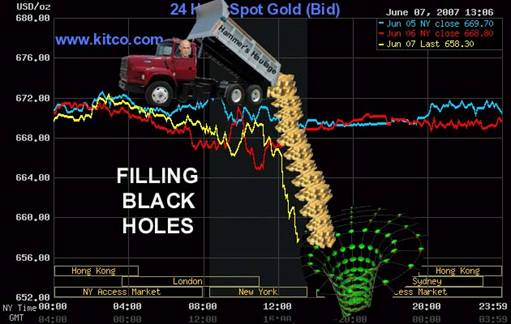
So ask yourself, in a world where Central Banks around the world are expanding fiat money supplies at double-digit growth rates – is this picture [disposing of real stuff at reduced prices for ever-depreciating currency] consistent with maximization of profits?
[more.....signup] [open pdf....members] |
Widely Under Reported Last Week
Last week, former Federal Reserve Chairman Alan Greenspan chimed in with ‘his take' on the likelihood of China pulling the plug on their willingness to hold U.S. Treasury Debt.
The good news:
“ There is little reason to fear a wholesale pullout by China out of U.S. government bonds, former Federal Reserve Chairman Alan Greenspan said on Tuesday.”
The bad news:
“ Greenspan said the reason such a withdrawal was unlikely was that China would not have anyone to sell the securities to.”
[more.....signup] [open pdf....members] |
Anecdotal Asides and Questions Begging Answers
The state of China 's equity market has made news again today with a steep drop of the Shanghai Stock Exchange of over 8 % being widely reported in the mainstream western press .
China shares tumble as panic spreads
Mon Jun 4, 2007 6:29AM EDT
By Andrew Torchia
SHANGHAI (Reuters) - China stocks tumbled 8.3 percent on Monday in their second biggest drop this decade, erasing $340 billion in market value and extending big losses from last week after the government hiked the share trading tax to cool a feverish bull run.
In an apparent attempt by authorities to restore confidence, front-page editorials in official newspapers tried to reassure investors the market's medium- and long-term outlook was still positive, and that the tax hike was merely aimed at speculators.
But that failed to stop selling by many of the anxious and often inexperienced individual investors who had jumped into the market in recent months for what seemed like easy money…..
I'm not going to question whether or not the Shanghai Exchange “took one on the chin” today – but I am curious enough to ask the question, “Was the steep drop fundamentally warranted or not?”
The reason[s] I'm curious goes like this:
· If the steep drop WAS NOT fundamentally warranted, this sell off represents a GREAT entry point to establish new ‘long positions' in Chinese equities. If the drop was warranted – what was the basis?
· Understanding the basis [reason] for such steep declines would possibly offer valuable insights as to what ‘markers' or ‘tell-tales' one might want to be aware of in other equity markets as potential warnings to either reduce positions or “get out of the pool altogether”, so to speak.
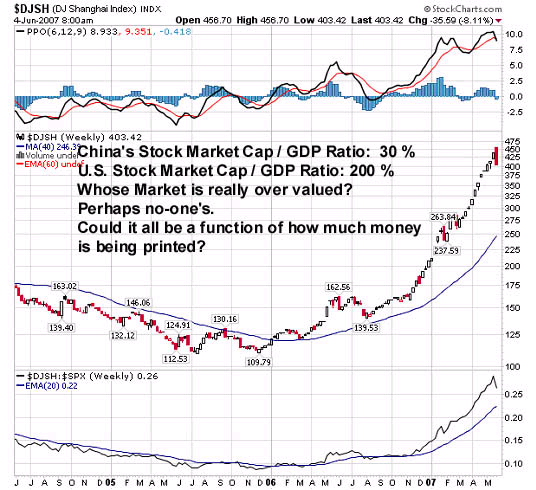
[more.....signup] [open pdf....members] |
The BMO Follies, the Mainstream Media and More..
These guys should take this comedy routine on the road. It was just 10 days ago that I penned a piece called, Derivative Disaster: Deriving the Truth , where I commented,
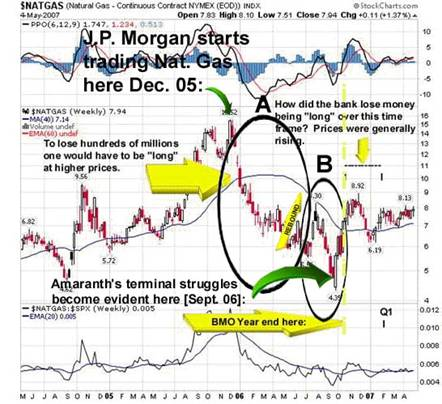
“For anyone who adheres to logic or reason - the chart above clearly shows that to incur losses trading Nat. Gas from the ‘long side' of the magnitude that BMO is now reporting [680 million at last count] – one would NECESSARILY have been “LONG NATURAL GAS” through one or both of the circled steep price declines depicted on the chart above [A and/or B].
What this means is that the BMO incurred their losses BEFORE their year end. So now, shouldn't we really be asking the question, Why weren't these losses reported in Q4 when they were incurred – and in all likelihood – were still much greater than they are being admitted to now?”
Then today, May 29/07 - Canada 's Globe and Mail Newspaper reported :
TARA PERKINS
Globe and Mail Update
May 29, 2007 at 7:38 AM EDT
The Bank of Montreal [BMO-T] filed its restated first-quarter results with regulators late Monday evening, and suggested for the first time that the problems in its commodity trading division began before November of last year . [RK emphasis]
While the words “I told you so” seem so cliche – I did, didn't I?
Not the first time either. [more.....signup] [open pdf....members] |
The I.M.F. In The News
This past week saw the International Monetary Fund [I.M.F.] publicly grousing about the sorry state of their finances.
LONDON (Reuters) - The International Monetary Fund is still considering whether to sell 400 tons of its gold stocks to help plug a widening income shortfall, the head of the global lender, Rodrigo Rato, said on Monday.
This same Reuters article pegged the I.M.F.'s income shortfall at $165 million for 2007 and an anticipated widening gap of 214 million projected for 2008. The stated reason for the income shortfall,
“.. demand for IMF financial assistance has almost dried up..”
Rumors of large scale I.M.F. gold sales are not new. Political do-gooders of different nationalities have been lobbying for various causes over the past few years – all seeming to require the “pre-announced” divestiture of large amounts of I.M.F. gold – as demonstrated by Great Britain 's Gordon Brown in this 2005 effort :
Gordon Brown Proposes Revaluation of IMF Gold Reserves to Fund Third World Debt
3rd February in Parliament
Third World Debt Reduction
Brown wants debts that cost the world's poorest nations -- mostly African -- $39 billion a year wiped out and is pushing for more even-handed trade rules and new long-term aid.
One of the ideas floated by Brown is revaluing part of the International Monetary Fund's gold reserves to finance debt write-offs for 27 of the world's poorest countries.
Because annual global gold production only runs in the 2,500 – 2,600 tonne level – threats of additional supply in the magnitudes often bandied about regarding I.M.F. stocks – like 400 tons – have historically tended to “stifle” a sharply increasing gold price or at times, even send the price plummeting.
[more.....signup] [open pdf....members] |
Derivative Disaster: Deriving the Truth
In an article I penned – two weeks ago – I discussed the misfortunes of the Bank of Montreal [BMO] and their costly foray into Natural Gas derivatives trading. In that piece I wrote what are now some rather prophetic words in my assessment of BMO and their 450 million “charge” against 2 nd quarter earnings, when I opined;
“This means that the BMO's ‘long natural gas position' was almost certainly a MUCH BIGGER LOSS – at one point in time – than they are admitting to us now.
BMO's year end is Oct. 31. I'm left wondering why they did not report a bigger loss last quarter.”
Then, this week, BMO announced they REALLY lost 680 million and they are now going to “restate” 1 st quarter earnings.
Amazing, eh?
But I suspect something is still not quite right. [more.....signup] [open pdf....members] |
Open Letter To Mr. Samuel Bodman, U.S. Secretary of Energy
U.S. Department of Energy
1000 Independence Ave., SW
Washington , DC 20585
E-mail: The.Secretary@hq.doe.gov
May 16, 2007
Mr. Samuel Bodman;
I took special note of your recent [i] announcement [ May 14, 2007 ]:
2007-05-14 12:30:25 US to halt oil purchases for strategic reserve until peak season ends - official
PARIS (Thomson Financial) - The US does not plan to buy more oil for its strategic petroleum reserve (SPR) until after the end of the peak demand summer driving season, US Secretary of Energy Samuel Bodman said.
I am having a difficult time rationalizing why the Energy Dept. would be considering limiting such SPR purchases?
As I'm sure you are well aware Mr. Bodman – the mainstream financial media has lately been chock full of stories regarding WHY West Texas Intermediate Crude Oil [WTI] is trading at an unusual ‘discount' to Brent Crude Oil [we both know it historically trades at a premium]. One such ‘story' recently ran in the Asia Times [ii] [ excerpted below ]:
“The reason WTI is losing relative value to Brent is that it's becoming harder and harder to do that at the traditional networks of refiners that service Cushing. The oil companies have recently shut down so much US refining capacity that there is no place for the crude oil at Cushing to go, no refinery with spare capacity to process it. The massive network of underground oil-storage tanks at Cushing is full, and oil being stored in tanks makes money for no one except the owner of the storage facilities. If you can't refine WTI, there's no reason to buy WTI.”
The crux of the explanations offered by these recent articles is that crude oil storage facilities in Cushing , Oklahoma are all full – with bottlenecks at refineries – explaining the relatively higher prices of gasoline and refined products. So my question to you Mr. Bodman is this; If storage facilities at Cushing Oklahoma REALLY are ‘full' – and a glut of crude oil truly exists - then why would the U.S. Government curtail crude oil purchases for the SPR NOW - when there is a well reported and alleged [relative] GLUT of crude oil? [more.....signup] [open pdf....members] |
Derivatives: Glowing Revelations
In case you haven't noticed the headlines about the Bank of Montreal [BMO] taking a “charge” against earnings relating to its [ DERIVATIVES ] trading – particularly in that of Nat Gas futures :
TORONTO , April 27 /CNW/ - BMO Financial Group (NYSE: BMO, TSX: BMO) said today that mark-to-market commodity trading losses estimated at between CDN$350 million and CDN$450 million, pre-tax, will be recorded in the second quarter of its 2007 fiscal year. The impact of this to BMO Financial Group's second quarter earnings, which will be announced on May 23, 2007 , is estimated in the range of 45 cents to 55 cents per share.
I'm guessing there's a much bigger story here than the headline suggests. Bank of Montreal has taken a loss on DERIVATIVES TRADING of some 450 MILLION – and remember – total trading revenue for the whole of last year for BMO was reportedly in the neighborhood of 650 million.
As the bank reported,
A number of factors contributed to these mark-to-market commodity trading losses. During the quarter, positions held by BMO Financial Group in the energy market, primarily for natural gas, were negatively impacted by changesu in market conditions. In particular, the market became increasingly illiquid and volatility dropped to historically low levels . In conjunction with this, there was a refinement in BMO's approach to estimating the market value of
this portfolio.
These adverse changes that gripped ole BMO in the latest quarter – well – it got me to thinking??????
What do you suppose would happen if the same ole adverse changes would do if they ever infected ole J.P. Morgan and their 68+ TRILLION DERIVATIVES BOOK ?????
Do any of you ever wonder why J.P. Morgan has a derivatives book this big?
It certainly has nothing to do with “real” end-user demand, now does it?
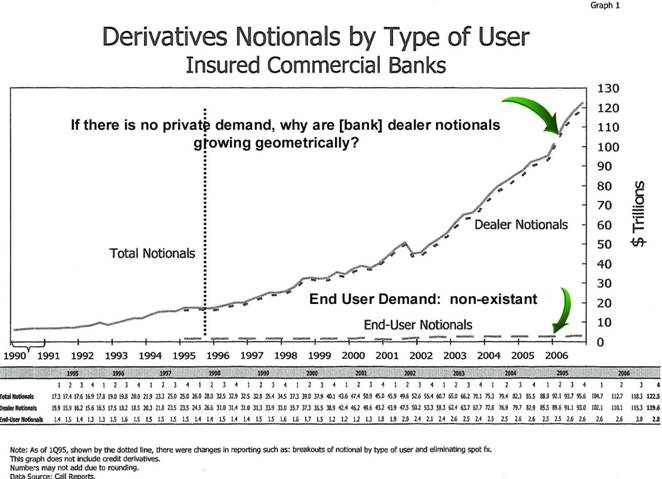
Source: Office of the Comptroller of Currency, Quarterly Derivatives Fact Sheet
[more.....signup] [open pdf....members] |
Blind, Blinder or Blind-Sided?
We should have seen this coming – I'm speaking of the continuing assault on the North American middle class – except it's got a slightly different ring to it this time around.
At risk now are 40 MILLION service jobs.
Don't believe it? See for yourself – here. In an April 17 editorial by Froma Harrop – which I caught flying under the radar in the Seattle Times – Harrop cites the recent work and assessment of Alan S. Blinder , noted Princeton Economist and former Vice Chairman of the Board of Governors of the Federal Reserve:

Alan S. Blinder
“The master plan, it seems, is to move perhaps 40 million high-skill American jobs to other countries. U.S. workers have not been consulted.
Princeton economist Alan Blinder predicts that these choice jobs could be lost in a mere decade or two. We speak of computer programming, bookkeeping, graphic design and other careers once thought firmly planted in American soil. For perspective, 40 million is more than twice the total number of people now employed in manufacturing.”
The loss of an ‘additional' 40 million high skill American jobs over the next decade or two equates to leakage [or rape, perhaps?] of somewhere between 2 and 4 million jobs per year!
Where does it all end? [more.....signup] [open pdf....members] |
Inconvenient Truths
Generally, I write about matters financial and specifically about the perpetuation of lies and misinformation by officialdom involved with the rigging of global financial markets – especially GOLD .
In case this point is lost on anyone, financial markets - and gold in particular – are rigged by officialdom so as to perpetuate Global U.S. Dollar hegemony [ie. the role of the U.S. Dollar as the world's sole reserve currency].
At this point in time, I would suggest there is a growing plurality of folks who recognize that Middle Eastern conflict is/was perhaps never about WMD's – but a much larger UNSTATED AGENDA : namely, the maintenance of U.S. Dollar [Petro-dollar] as the world's reserve currency – AT ANY COST .
I bring the following point to everyone's attention because it clearly illustrates the lengths that officialdom will go to defend their unstated, not so hidden, agenda.
I also present this episode as a ‘case study' employing the same investigative techniques outlined in a previous piece I penned, titled, Forensic Economics 101 .
For those who share the thoughts exemplified by the mainstream financial media - who feel that financial market rigging BY OFFICIALDOM is a stretch – you'd better go pour yourself a stiff drink before you read this. [more.....signup] [open pdf....members] |
Driven To Fudge Numbers
Much has been written lately regarding the woes of the North American Auto Industry and why they seemingly cannot compete.
Reasons proffered as to why the North American auto industry has fallen upon such hard times run the gamut from quality issues to aging work forces to greedy unions.
One of the less talked about or ignored issues that has greatly impacted the plight of the auto industry is the misreporting of inflation - thanks to financial shenanigans by Central Bankers like the Federal Reserve.
How Does This Impact Car Companies?
The misreporting of inflation statistics has materially impacted the prospects of the Auto Companies – but it goes further than that. The reality is that all mature companies with aging work forces and ESPECIALLY non-defence industry related companies with Defined Benefit Pension Plans are at risk.
Consider This:
Framers of these pension plans – who carefully set them up many years ago – knew very well, and planned accordingly for, the changing demographics of their work forces. They knew that folks would age and retire. They used sound planning to ensure that the proper amount of assets would be set aside to look after those whose labour was responsible for the company's growth.
But here's what happened:
[more.....signup] [open pdf....members] |
Lost In the Weeds
Today, I would like to touch on a couple of seemingly innocuous developments which I learned of in the past week.
First, I would like to direct everyone's attention to a piece penned by Jim Willie – titled, Gold Sniffs Rate Cut . I consider the piece a ‘must read' for anyone trying to make sense of today's conflicted news reporting being served up by mainstream financial news outlets.
Regarding Mr. Willie's article – I would specifically like to draw everyone's attention to this passage,
“ Why just last week the Board of Governors at the Federal Reserve System voted to reduce disclosure requirements in what are known as Call Reports for major shareholders and officers for member banks.”
This charge by Willie left me with my head shaking. Here's why:
If you visit this page , which is published by the Comptroller of the Currency – Administrator of National Banks, you will notice that,
“ Each quarter, based on information from the Reports of Condition and Income ( call reports ) filed by all banks, the Office of the Comptroller of the Currency prepares a Fact Sheet. That fact sheet describes what the call report information discloses about banks' derivative activities.”
The information ‘disclosed' in these very call reports represents the ONLY gleaning we receive on the make up and changes of the book size of derivatives behemoths like J.P. Morgan Chase and their [as of Q3/06] 63 TRILLION notional positions. [more.....signup] [open pdf....members] |
Not Your Average Prospect
At this year's PDAC I had the pleasure of meeting one of Canada 's most celebrated prospectors, Don McKinnon. With more than 45 years of experience in the international mineral exploration industry, Mr. McKinnon is renowned for the discovery of Hemlo, one of Canada 's largest and richest gold mining camps. I had a lengthy chat with McKinnon and learned he had just published a book, THE SCHOLARLY PROSPECTOR , and then went on to explain what else is occupying his time these days.
Baltic Resources [TSXV: BLR ]– Chaired by Canadian mining icon Don McKinnon – is one of Canada's newer juniors, currently with 3 projects underway in Northern Ontario, Canada.
Who would want to bet against Baltic's chances for success in Northern Ontario ; it's McKinnon's ‘own backyard'. [more.....signup] [open pdf....members] |
Deep Storage, Deeper Holes, Deepest of Trouble
I'd like everyone to take a look at the U.S. Treasury's most recent accounting of its gold:
Department of the Treasury
Financial Management Service
STATUS REPORT OF U.S. TREASURY-OWNED GOLD
January 31, 2007 |
Summary |
Fine Troy Ounces |
Book Value |
|
|
|
|
|
Gold Bullion |
258,641,851.485 |
$10,920,427,976.14 |
Gold Coins, Blanks, Miscellaneous |
2,857,047.831 |
120,630,844.95 |
|
|
|
|
|
Total |
261,498,899.316 |
11,041,058,821.09 |
|
|
|
|
|
Mint-Held Gold - Deep Storage |
|
|
|
|
|
|
|
Denver , CO |
43,853,707.279 |
1,851,599,995.81 |
Fort Knox , KY |
147,341,858.382 |
6,221,097,412.78 |
West Point , NY |
54,067,331.379 |
2,282,841,677.17 |
Subtotal - Deep Storage Gold |
245,262,897.040 |
10,355,539,085.76 |
|
|
|
Mint-Held Treasury Gold - Working Stock |
|
|
All locations - Coins, blanks, miscellaneous |
2,783,218.656 |
117,513,614.74 |
Subtotal - Working Stock Gold |
2,783,218.656 |
117,513,614.74 |
|
|
|
|
|
Grand Total - Mint-Held Gold |
248,046,115.696 |
10,473,052,700.50 |
|
|
|
|
|
Federal Reserve Bank-Held Gold |
|
|
|
|
|
|
|
Gold Bullion: |
|
|
Federal Reserve Banks - NY Vault |
13,376,961.126 |
564,804,727.98 |
Federal Reserve Banks - display |
1,993.319 |
84,162.40 |
Subtotal - Gold Bullion |
13,378,954.445 |
564,888,890.38 |
|
|
|
|
|
Gold Coins: |
|
|
Federal Reserve Banks - NY Vault |
73,808.979 |
3,116,377.47 |
Federal Reserve Banks - display |
20.196 |
852.74 |
Subtotal - Gold Coins |
73,829.175 |
3,117,230.21 |
|
|
|
|
|
Total - Federal Reserve Bank-Held Gold |
13,452,783.620 |
568,006,120.59 |
|
|
|
|
|
Total - Treasury-Owned Gold |
261,498,899.316 |
$11,041,058,821.09 |
|
|
|
|
|
*Deep Storage: Deep-Storage gold is the portion of the U.S. government-owned Gold Bullion Reserve that the U.S. Mint secures in sealed vaults, which are examined annually by the Department of Treasury's Office of the Inspector General. Deep-Storage gold comprises the vast majority of the Reserve and consists primarily of gold bars. This portion was formerly called "Bullion Reserve" or "Custodial Gold Bullion Reserve."
*Working Stock: Working-Stock gold is the portion of the U.S. government-owned Gold Bullion Reserve that the U.S. Mint uses as the raw material for minting congressionally authorized coins. Working-Stock gold comprises only about 1 percent of the Reserve and consists of bars, blanks, unsold coins, and condemned coins. This portion was formerly listed as individual coins and blanks or called "PEF Gold."
I would particularly like to draw everyone's attention to the highlighted part of the table above and then to consider the ‘genesis' of the definition of Deep-Storage gold – as it's explained in the accompanying notes at the bottom of the data. [more.....signup] [open pdf....members] |
Crude Revelations
We hear much in the media regarding the cost of the war in Iraq in terms of lives lost – the human costs – and hardly a week goes by without some media account – or debate - of the war's cost in dollar terms.
“Even if the U.S. exits Iraq within another three years, total direct and indirect costs to U.S. taxpayers will likely be [sic] more than $400 billion, and one estimate puts the total economic impact at up to $2 trillion.”
While it's not my intention, in this space, to diminish the importance of these headline grabbing issues – I would like to draw the readers' attention to a few additional crude facts.
Most if not all of us are well aware that Iraq holds the world's second largest conventional oil reserves. Heck, even the U.S. Government acknowledges this fact,
“Nonsense aside, the sands of Iraq hold oil... lots of it. According to the US Energy Information Administration (EIA) , " Iraq holds more than 112 billion barrels of oil - the world's second largest proven reserves. Iraq also contains 110 trillion cubic feet of natural gas, and is a focal point for regional and international security issues."
And let's not forget the future potential ;
“While its proven oil reserves of 112 billion barrels ranks Iraq second in the world [sic] behind Saudi Arabia, EIA estimates that up to 90-percent of the county remains unexplored due to years of wars and sanctions. Unexplored regions of Iraq could yield an additional 100 billion barrels.”
Interesting, isn't it, that when one speaks of Iraq, crude oil and future potential – you intuitively know that a discussion relating to BANKING, FIAT MONEY and FUTURES cannot be far behind. [more.....signup] [open pdf....members] |
Dead Presidents' Society
We truly do live in a complex world, don't we?
We have jobs, families, outside interests, concerns about the environment, concerns about our health, taxes and mortgages to pay, along with the rising costs of food, energy and housing.
Sometimes it's hard to make sense of it all - quite a rat race, isn't it?
Have you ever noticed how every now and then, someone steps forward and says or does something that resonates so clearly – clarity descends on mayhem - it's like bells go off in your ears?
I recently had one of those eye opening experiences when I listened to famed Hollywood director - Mr. Aaron Russo, being interviewed by Paul Joseph Watson.
Elementary, My Dear Watson
For me, the poignant moment in Watson's interview was when Russo revealed that after his popular video Mad As Hell was released and he began his campaign to become Governor of Nevada, Russo was noticed by [Nick] Rockefeller and introduced to him by a female attorney. Seeing Russo's passion and ability to affect change, Rockefeller set about on a subtle mission to recruit Russo into the [ CFR ] elite.
During one conversation, Rockefeller asked Russo if he was interested in joining the Council on Foreign Relations (CFR) but Russo rejected the invitation, saying he had no interest in "enslaving the people" to which Rockefeller coldly questioned why he cared about the "serfs."
The interview continues with Russo revealing,
"I used to say to him what's the point of all this," states Russo, "you have all the money in the world you need, you have all the power you need, what's the point, what's the end goal?" to which Rockefeller replied (paraphrasing), "The end goal is to get everybody chipped, to control the whole society, to have the bankers and the elite people control the world."
Rockefeller even assured Russo that if he joined the elite his chip would be specially marked so as to avoid undue inspection by the authorities.
This all sounds deliciously conspiratorial, doesn't it? [more.....signup] [open pdf....members] |
Contrary Views On The News
There's been much reported in the mainstream financial media in recent weeks that the commodities bull market is either “long in the tooth”, a bubble looking for a place to burst, or in fact - finished.
For regular readers of this space or listeners of Jim Puplava's weekly radio show, you've been reminded on more than few occasions – bubbles – by definition, are signified by rising inventories or gluts.
But for anyone who listens to CNBC or reads any of the mainstream financial press's offerings – a housing-led slowing of U.S. consumption spells bad times ahead for commodities.
The Importance of China Re: Commodities
A fellow contributor at Financial Sense, Jennifer Barry , also contributes economic thought in another forum – The James Joyce Table at Lemetropolecafe.com .
Over the past couple of years in this forum, Ms. Barry – along with other economic thinkers like Jeff Dahl [CEO - Samex Mining ] and others have developed the thought that China has been hoarding base metals as a “hedge” on their TRILLION dollar foreign exchange position. Last week, in the same forum, Dahl surmised that,
“…the Chinese have copied a strategy from the gold price managers, only in reverse; instead of hedging metal (selling forward) they have hedged their trillion dollars (sold it forward, while people were still willing to except dollars for real things)!”
Mr. Dahl uttered these words just last week in response to Chinese Premier Wen Jiabao , who said,
"….The foreign reserves are not treasury capital, but liabilities of the central bank, which means they cannot be used wishfully," said Prof Zhao Xijun with the People's University.
China needs foreign exchanges to meet its payment requirement for import and export. Apart from that, the surplus should be best allocated and invested to achieve highest returns, said Lin Yifu, a renowned economist from Peking University 's China Center for Economic Research.
He stressed that any use of foreign reserves have to be fully discussed and carried out in a very prudent way.
" To actively explore and expand channels of using foreign reserves will be a major point in future work ," he said.
As Dahl sees it, the importance of this speech by the Chinese Premier is this,
“…this announcement is basically a "coming out of the closet" admission on their part. Unlike the gold price managers , I don't think that they [Chinese] would "pre-announce" their trade-agenda (purchasing-plans). My bet is that, probably over 70% of the "touted" trillion is all ready spent in forward purchase contracts around the world, for all forms of commodities, that will be regularly delivered on over the next fifteen years or so.” [more.....signup] [open pdf....members] |
Forensic Economics 101
How many of you have ever heard of the term ‘postmortem'? For those of you who have not – it's a procedure in a branch of Medical Science that developed to enable folks to clearly and unambiguously identify cause of death.
Another science that boasts its own forensic branch is that of Engineering. When catastrophic failures occur, be they structural, mechanical or electrical; forensic engineers are often charged with determining – procedurally through examination and documentation - exactly what happened.
The reason[s] why anyone would want to discern “what happened” should be obvious to most – they range from liability and insurance issues to ensuring that criminal wrong-doers are brought to justice.
But what about the dismal science – economics?
Forensic economics is the scientific discipline that applies economic theories and methods to the issue of pecuniary damages as specified by case law and legislative codes. Topics within forensic economics include (1) the analysis of claims involving persons, workers, firms, or markets for evidence concerning damage liability; (2) the calculation of damages in personal and commercial litigation; and, (3) the development and use of generally accepted forensic economic methodologies and principles.
The Wikipedia definition of forensic economics above conveys the ‘basic concept' but primarily in a micro-economic or “dismal” case study sense. What I'm suggesting is that the definition of Forensic Economics needs to be fundamentally REWRITTEN to reflect the fact that its practice deals with the fundamental issues of what money is – or ought to be - and how it derives its value. Moreover, the definition of Forensic Economics needs to be rewritten to acknowledge and make room for a new breed of economic thinkers – ones concerned with uncovering and making right what the “ DISMALITES ” before them have made so very wrong. Few, if any, would argue that official government statistics – as reported – run the gamut from little white lies to blatant whoppers. Celebrated practitioners of forensic economics already include such notables as John Williams of Shadow Government Statistics. , ‘Midas' Bill Murphy's GATA group along with Doug Noland and his Credit Bubble Bulletin and the rest of the crowd over at David Tice's Prudent Bear . [more.....signup] [open pdf....members] |
CNN – Cabal News Network
In the aftermath of President Bush's speech last night, I sat and listened to CNN's Larry King interview a panel of “experts” that began with sen. Barack Obama and included former senator and candidate for Democratic Presidential nomination John Edwards, senators John McCain, Lindsey Graham, John Warner and Ms. Dianne Feinstein – all elected.
While interviewing Mr. Edwards, Larry King cut to a graphic that cited an editorial quote – pertaining to the present situation in Iraq - from “the famed Former Council On Foreign Relations [CFR] President ” – Leslie Gelb . While Mr. Gelb is no doubt qualified to offer valuable, pertinent and interesting insight on the Iraq situation as a Pulitzer Prize winning journalist, former correspondent with the New York Times and an official in the State and Defense Departments – which the last time I checked, ARE branches of the ELECTED government – but CNN only introduced him as famed former President of the CFR. Larry King asked Mr. Edwards to respond to this quote – which he did.
I couldn't help but think to myself “ Why is CNN [Larry King] trying to inject the views of the unelected CFR into this discussion ?” It was a blatant and deliberate [but disguised, perhaps?] attempt to give this organization credibility and standing in the public eye.
[more.....signup] [open pdf....members] |
Base Metal Bogie Man
I've taken particular note of how the prices of most of the base metals have been “HAMMERED” lately. In fact, I've been shaking my head by the number of “experts” being trotted out on CNBC and ROB TV making the claim that copper inventories have now got a supply overhang and how they've even got people believing there might be a commodity price implosion due to these “ballooning inventories” – eg. see Clive Maund .
To his credit, Mr. Maund's short term prognostication – that being for metals prices to decline – is very accurate.
But let's examine his analysis: [more.....signup] [open pdf....members] |
Letter To the Editor
Year end is generally a great time to reflect back on the year that was. Doing so often allows one to consolidate their thoughts – or perhaps gives cause to “bind” a collection of thoughts into a more concise, comprehensive framework.
I was prompted to reflect back a bit myself in recent days – by a fellow writer, who, after reading a recent piece of mine – took umbrage and contacted me, questioning my apparent disregard for technical analysis and slighting of the mainstream financial press.
My response to this query seemed to me to have substance of its own and enough “flow” – that I actually added a bit to it and decided I'd share it with a wider audience;
XXXX;
Actually, I really raised the question as to the value of both technical analysis and fundamental analysis. My point is that everyone should stop and consider the quality of the INPUTS [data provided by conflicted parties] and base assumptions.
I have a great deal of respect for both Tim Wood and Frank Barbera – and their work – and their discipline. Frankly, having grown up in the Institutional markets in the 1980's – I've witnessed the power and predictability of TA [technical analysis] in what used to be FREE MARKETS.
Interestingly, we didn't have “conundrums” back then. When money supply meant something and it grew too fast – the bond market vigilantes barked – and EVERYONE listened - rates when up until money growth slowed and recessions happened.
[more.....signup] [open pdf....members] |
A Tale In Three E-Mails
The following is a series of three e-mails that were private correspondence with Bill Murphy of Lemetropolecafe.com over the past few days:
Bill;
I've been thinking the concept of " gold quality swaps " over and over again in my mind. At first, my belief was that the U.S. had only categorically done "gold quality swaps" with the Bank of England – only because the Bank of England is the only Central Bank that officially acknowledges they have such trades on their books.
That they do is now matter of historical fact.
But now, my thinking has changed.
I now believe that gold quality swaps were, perhaps also, conducted with the Bundesbank around the year 2000.
I now feel that "Quality Gold Swaps" were "coined" [pun intended] or invented for a darker reason.
My thinking is now that fine "deliverable" gold from the Bundesbank was perhaps "swapped" for "DEEP GOLD".
After all, DEEP GOLD is only gold of a different "fineness" – isn't it?
Quality Gold Swaps by the U.S. with Central Banks around the world would – utilizing DEEP GOLD [gold in the ground] - would go a long way – perhaps a better explanation - to explaining why the gold price suppression has been able to be extended for such a long period of time.
It would also provide a "fuller explanation" as to why the Central Banks are so opaque when it comes to double-counting "swapped gold" visa vie "gold in the vault".
A work in progress, [more.....signup] [open pdf....members] |
A Weekend At Bernankes
Way back on Oct. 27, 2006 – when the Commerce Department released their first GUESS as to what Q3 / 06 GDP might be – their initial estimate was published at +1.6 %. For those of you with short memories, let me give you a little “ Bloomberg ” refresher:
“Last quarter's annualized 26 percent increase in motor vehicle production shocked Joe Carson, now director of economic research at AllianceBernstein LP in New York . Without the gain, the economy would have grown at an annual rate of 0.9 percent, not the 1.6 percent the Commerce Department reported today.” [more.....signup] [open pdf....members] |
Don't Believe Everything You Hear
One of my favorite weekend pastimes is listening to the Financial Sense Newshour , hosted by Jim Puplava each weekend and broadcast on the internet. This past weekend in the show's 3 rd hour, in a segment called “other voices” - Jim interviewed well known investment letter writer Dennis Gartman [begins at 21:20 ], author of the Gartman Letter.
Mr. Gartman opined that in the wake of Democratic mid-term electoral successes that legislative grid-lock would be a likely outcome in the upcoming Congress. Mr. Gartman sees these prospects of ‘limited government' as the pretext for equity markets to move higher. In responding to Jim's questioning about the current state of inventories of base metals Mr. Gartman intimated that ‘inventories as low as they are today' are unsustainable and inventories will in all likelihood build because in Mr. Garman's words, referencing current copper prices for example which he describes as,
“egregiously, preposterously, stunningly, shockingly high.”
Mr. Gartman presumes that prices for these commodities will fall over the next six to twelve months as inventories build as a result of a supply side response [companies rushing out to bring more of these ‘expensive goods' to market]. [more.....signup] [open pdf....members] |
They All Rolled Over And One Fell Out
For those of you watching the ticker on your T.V. screens and noticing the spot price of crude oil dropping like a stone – don't worry too much. The price of oil is not likely to fall to zero anytime soon.
The price being displayed on your screen is in fact the futures price of what is known as the spot crude oil. Today, November 16, 2004 the spot month for crude oil is the December 2006 futures contract.
Trading of this contract ceases tomorrow , November 17:
Delivery Month |
Termination of
Trading |
Notice Day |
Allocation of Deliveries |
First Delivery
Day |
Last Delivery
Day |
|
2006 |
| January |
Dec 20, 2005 |
Dec 22, 2005 |
Dec 21, 2005 |
Jan 1 |
Jan 31 |
February |
Jan 20 |
Jan 24 |
Jan 23 |
Feb 1 |
Feb 28 |
March |
Feb 21 |
Feb 23 |
Feb 22 |
Mar 1 |
Mar 31 |
April |
Mar 21 |
Mar 23 |
Mar 22 |
Apr 1 |
Apr 30 |
May |
Apr 20 |
Apr 24 |
Apr 21 |
May 1 |
May 31 |
June |
May 22 |
May 24 |
May 23 |
Jun 1 |
Jun 30 |
July |
Jun 20 |
Jun 22 |
Jun 21 |
Jul 1 |
Jul 31 |
August |
Jul 20 |
Jul 24 |
Jul 21 |
Aug 1 |
Aug 31 |
September |
Aug 22 |
Aug 24 |
Aug 23 |
Sep 1 |
Sep 30 |
October |
Sep 20 |
Sep 22 |
Sep 21 |
Oct 1 |
Oct 31 |
November |
Oct 20 |
Oct 24 |
Oct 23 |
Nov 1 |
Nov 30 |
December |
Nov 17 |
Nov 21 |
Nov 20 |
Dec 1 |
Dec 31 |
[more.....signup] [open pdf....members] |
Actions, Reactions and Distractions
Much has happened in the past 7 days. In the U.S.A. , Democrats have retaken both House and the Senate for the first time since 1994. On a macro / geo - economic level – this move is almost universally viewed as being a shift toward advocacy of “fair trade” as opposed to unbridled “free trade”. In econo-speak this is referred to as a move toward protectionism.
While the extent to which the U.S. actually does or does not follow through with legislation in this regard – there has already been fallout, or perhaps more accurately stated – “a shot over the bow” – from America 's biggest beneficiary of free trade. Take special note of the timing – November 9, two days after the American mid-term elections – of People's Bank of China head, Zhou Xiaochuan,
``All central banks are trying to diversify,'' People's Bank of China Governor Zhou Xiaochuan said at a conference in Frankfurt . ``We have had a very clear diversification plan for several years.''
[more.....signup] [open pdf....members] |
A Few Words On A Major Taxation Event In Canada
TEXT -Finance Canada statement on income trust taxation
“ OTTAWA , Oct 31 (Reuters) - The Canadian finance ministry issued the following statement relating to changes to taxation, especially of income trusts:
The Honourable Jim Flaherty, Minister of Finance, today announced a Tax Fairness Plan for Canadians. The plan will restore balance and fairness to the federal tax system by creating a level playing field between income trusts and corporations.
"The measures I am bringing forward today are necessary to restore balance and fairness to Canada 's tax system, to ensure our economy continues to grow and prosper and to bring Canada in line with other jurisdictions," said Minister Flaherty. "Our plan is the result of months of careful consideration and evaluation. Our actions are clear, decisive and in the best interest of all Canadians." …………………” [more.....signup] [open pdf....members] |
Failure To Deliver or “Deliverance”?
This past Friday [ Oct. 27, 2006 ] I had the opportunity to sit at my desk and listen to this slide / narrative presentation titled, Darkside of the Looking Glass . Anyone who owns or trades stocks must experience this presentation.
I suggest that this will cast light on the shadowy corners of our equity [capital] markets and the lack of probity and integrity of our regulators. These players, who till now have been left to self-regulate, are now self-serving at the expense of “ WE ” the public. This also calls into question just how far up the food chain knowledge of these improprieties really go?
Remember folks, knowledge is power.
Overview:
The narrative explains, with the aid of graphics, stock settlement mechanisms on the large exchanges. It clearly illustrates how some broker-dealers and their biggest clients - hedge funds and their financial backers can, and do “game” [commit FRAUD] the Depository Trust Clearing Corporation [DTCC]. The DTCC is supposed to act as a back office for Wall Street firms – electronically settling inter-dealer equity transactions.
[more.....signup] [open pdf....members] |
A Swap Story: Borrowed From The Bank of England
Every now and then even the most unwitting prospector finds a nugget in his pan. Recently, with a little help from my friends – O.K., with a lot of help from my friends – this golden revelation just happened to bonk me straight between the eyes;
WASHINGTON (Dow Jones)-- U.S. gold exports rose 55.0% in August from the previous month, and was up 83.0% from the previous year, the Commerce Department reported Thursday.
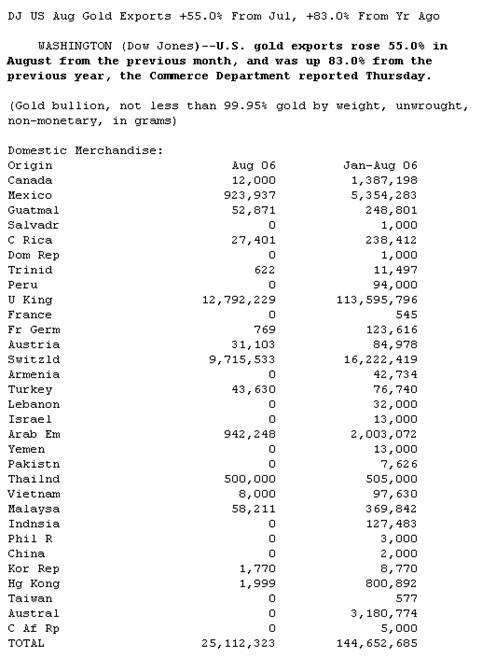
So, I'm sure many of you are figuring, “big deal”, gold exports from the U.S. are up – so what? [more.....signup] [open pdf....members] |
The Honey Pot
In a couple of earlier articles, we've examined the relationship between first – plunging natural gas prices and the “astounding ramp-up” of notional in J. P. Morgan's derivative book in Q1:06. Then we took a look at the re-jigging of Goldman Sachs Commodity Index [GSCI] and its deleterious effects on the price of gasoline – just in time to bolster crumbling Republican popularity ratings prior to the crucial mid – term elections.
This essay serves to complete the energy tri-fecta with a little contrarian's look-see into some of the possible reasons as to what or who might be influencing the manic swings we've been experiencing in crude oil prices .
Background: All Roads Lead To Baghdad
As early as June of 2003, we know that certain American banking institutions were eying and sizing up potential new business in Iraq ,
“Three of the top US banks, including J.P. Morgan , Citigroup and Bank of America, have set their eyes on the lucrative banking business in Iraq, according to a recent report in The Wall Street Journal. These banks and several others have conferred with Treasury Department officials in recent weeks. They are said to be interested in helping the Iraqis build a modern retail banking system as well as with trade finance , payments systems and foreign currency exchange …..” [RK bold emphasis]
Amazing isn't it, how some helpful folks set up an English language web site so they could keep all of us in the Western World apprised of the ‘late breaking news items' deemed important for us to get snippets of? Also, ever stop to wonder what the poor Iraqis would have done without the “help” of the likes of good ole J.P. Morgan Chase? Just think – a nice shiny, new retail banking system – yummy!!! And what's this about TRADE FINANCE, PAYMENTS SYSTEMS AND FOREIGN EXCHANGE ? What could a war torn, debilitated bombed out infrastructure that is and was Iraq possibly have that would be of interest to good ole J.P.M? I mean, exactly what does Iraq have that the rest of the world wants or needs besides oil?
[more.....signup] [open pdf....members] |
The Ibbotson Report Revisited Ibbotson Associates of Chicago were contracted by Bullion Management Services Inc. of Toronto to prepare a comprehensive study regarding the effects of portfolio diversification with Gold, Silver and Platinum Bullion. Their findings were published in June 2005 and concentrated on the period between 1971, when the price of gold was ‘allowed to float' with President Nixon's abrogation of the Bretton Woods System and the present [2005]. “The three metals were chosen because gold and silver are often viewed as a safe harbor in times of crisis. Conversely, during economic expansion demand for silver and platinum is thought to increase.” The ‘net result' of this study, utilizing back-testing, was the conclusion that “all” portfolios, whether of a conservative, moderate or aggressive risk appetite – benefited from the inclusion of basket of the three above named metals in the percentages of 7.1 %, 12.5 % and 15.7 % respectively. [more.....signup] [open pdf....members] |
Round Tripping
I've been around, how about you? I've been pushed around, screwed around, led around the block on more than one occasion - which coincidentally, some of you might better know as being ‘led down the proverbial garden path'. Oh, I've run around, been on merry-go-rounds, was married once to someone who ‘slept around', heck, I've even read the book around the world in ninety days! Around town; uptown, midtown and downtown – I've done the rounds. Round tables, round-a-bouts, round cheeks and round house – now you've got to get a kick out of that!
I'm not messing around here – just looking for good segue to what I really want to talk about; round tripping.
Now, I'd like you all to consider the following recent confessions from energy firms about "round trip" trades :
“Reliant admitted 10 percent of its trading revenues came from ``round-trip'' trades. The announcement forced the company's president and head of wholesale trading to both step down.
DMS Energy announced 80 percent of its trade in 2001 were ``round-trip'' trades.
That means 80 percent of all of their trades that year were bogus trades where no commodity changed hands, and yet the balance sheets reflect added revenue. If that isn't fraudulent, I do not know what is.
Remember, these trades are sham deals where nothing was exchanged.
Duke Energy disclosed that $1.1 billion worth of trades were ``round-trip'' since 1999. Roughly two-thirds of these were done on the InterContinental Exchange; that is, the online, non-regulated, non-audited, non-oversight for manipulation and fraud entity run by banks in this country. That means thousands of subscribers would see false pricing.
A lawyer for J.P. Morgan Chase admitted the bank engineered a series of ``round-trip'' trades with Enron.
Dynegy and Williams have also admitted to ``round-trip'' trades.
Although these trades mostly occurred with electricity, there is evidence that suggests that ``round-trip'' trades were made in natural gas and even broad band.”
[more.....signup] [open pdf....members] |
The Fool's Overture:
Casual Conversations
Having spent the bulk of the 1980's and 1990's involved as a broker, in institutional capital markets; I was privy to some of the most brilliant financial thinkers of their time. One such thinker [a Ph. D. in mathematics] was largely responsible for building the computer models – in the early 1980's - that allowed the global banking concern he worked for to “account for and book profits” on their global interest rate derivatives positions [interest rate swaps and FRA's]. This individual also just happened to be the “co-book runner” or co-trader of one of the world's very largest interest rates derivatives books at the time. While being of Polish extraction and he did speak in broken English; this gentleman was well known in the market to be an utter genius.
Now, I'd like to take you back in time to the summer of 1987. I was at lunch at a fashionable eatery [there were 4 of us] with my boss, my derivatives trading client and his workmate. Over small talk about the state of the economy and the near term direction of interest rates, our Polish mathematician blurts out, “I can see a day when the stock market [DOW] goes down four, five or six hundred points – no problem.” Needless to say, the other three of us sitting at the table nearly choked on our tongues. After questioning our friend as to his rationale for such a bold statement [the DOW was at 2,000 at the time] he explained that Portfolio Insurance was, in fact, THE reason why the stock market would suffer a decline like he had just described.
Understand that Portfolio Insurance had been designed largely by mathematicians and, when employed, resulted in computer generated equity trades that “sold” ever increasing amounts of a user's stock portfolio as the index level [DOW] declined ostensibly as a hedge to “protect” the value of what remained. Our Polish friend had studied and modeled the assumptions that under laid not only the concept but its execution.
What he found was a critically flawed system – in widespread use – that in effect turned the equity market into a tinder box with a short fuse. The faulty assumption that belied Portfolio Insurance was that the stock market behaved in a “linear fashion” and, in effect, incorrectly assumed that there would “always” be a bid. All that was required to ignite the whole shooting match was a spark. Needless to say, less than two months later that spark appeared and the stock market dropped more than 500 points [about 25 %] on that fateful Monday.
Amazingly, virtually no players in mainstream finance ever saw the folly in a program that they placed their complete faith in. The attempts to remedy the shortcomings of Portfolio Insurance in the aftermath of the 1987 crash involved the installation of “ Circuit Breakers ” – which curb/cease computer assisted or all exchange trading after milestones are reached on the up or downside on the relevant indexes. Perhaps of more relevance, by virtue of Executive Order 12631 , on March 18, 1988 - this led to the establishment of the Working Group on Financial Markets or the Plunge Protection Team [PPT].
Depending on the extent of official intervention, the remedial actions outlined above go a great ways to remove the nonlinearity from financial markets. Ultimately, markets that are regulated by omnipotent organizations like the Federal Reserve and the Working Group, armed with the ability to print unlimited amounts of cash out of thin air and buy and sell equity futures at their own discretion – would seem to have the ability to keep a lid on, or at least maintain financial markets with a semblance of order. Heck, we even recently learned ,
“The President just delegated authority to John Negroponte that allows him to exempt any publicly traded corporation that is working on national defense issues or national security issues from the reporting and accounting requirements under the 1934 Securities and Exchange Act. It's basically the rules and regulations that require companies to keep accurate records, accurate books, accurate accounting . . . and then disclose those projects and that information to investors……” [RK emphasis]
Make no mistake folks, what is outlined above IS CATEGORICALLY NOT A DESCRIPTION OF FREE MARKETS , or at least, not the kind of free markets that I was ever taught about. The markets outlined above would make any devote Communist “drunk with central planning envy”. It's that simple.
So, on the surface – everything might seem to be in place to allow the PPT to perpetuate this illusion of Free Markets behind their Houdini-esque Central Planning Charade. Funny thing; most of us have been taught to believe that Central Planning is destined to failure. As Sir Alan Greenspan himself once said ,
“Centrally planned economic systems, such as that which existed in the Soviet Union , had great difficulty in creating wealth and rising standards of living. In theory, and to a large extent in practice, production and distribution were determined by specific instructions--often in the form of state orders…..”
Has anyone stopped to notice that the U.S. now creates more debt than wealth and living standards are now falling ?
Lord Is It Mine?
A rising price of gold and silver has historically “blown the lid” off deceitful practices of monetary authorities when they debased their currencies [printed too much money]. Nowadays, in a world whose trade is dominated by paper/derivative or proxy trade, the bulk of precious metals trade customarily takes place on ‘futures exchanges' like COMEX [a division of NYMEX ] or the London Bullion Market Association [ LBMA ]. In such an environment, nefarious activity like the suppression of bullion prices is possible since, HISTORICALLY , the vast majority of trades are settled in fiat currency. This historic truth is largely due to market participant's acceptance to speculate on price movements in the underlying commodity, trusting the value of the settlement currency, the dollar, – instead of opting to take delivery and hold physical metal – or real money.
We know that physical gold and silver IS REAL MONEY because Section 10 of the Constitution for the United States of America tells us this is so.
Oh Darling
If you have ever seen The Wizard of Oz , you would be aware that when Dorothy and friends go before the omnipotent and all powerful Wizard; – it's Dorothy's dog, Toto, who ultimately reveals the Wizard – hiding behind the black curtain – exposing his trickery.
Well folks, I'm going to bet all of my chips that the dog in this developing story is going to end up being “ PHYSICAL PRECIOUS METAL – GOLD AND SILVER ”. Unlike fiat money, which can be printed in “any amount” out of thin air, physical gold and silver must be mined from the earth. Recent bouts of reckless money printing - particularly on the part of U.S. monetary authorities - have re-ignited not only private investment but global Central Bank demand for physical metal as a means to diversify their foreign reserve U.S. dollar holdings.
The trouble with this development, for the status quo, is that the world already had/has a structural supply/demand deficit where total supply [mine supply, which is shrinking, and scrap gold] was already 1,500 tons per year below global demand. This shortfall has been made up by dis-hoarding of Western Central Bank vaulted gold stocks for at least the past 10 years.
Asylum?
The World Gold Council publishes data suggesting that Central Bank's vaulted stocks are in the magnitude of 30.5 thousand tons of gold bullion. However, there are many who dispute this claim. But it's worthy of note that the World Gold Council either dismisses or suggests investment demand is of little or no consequence as their latest report [Q1-06] shows :
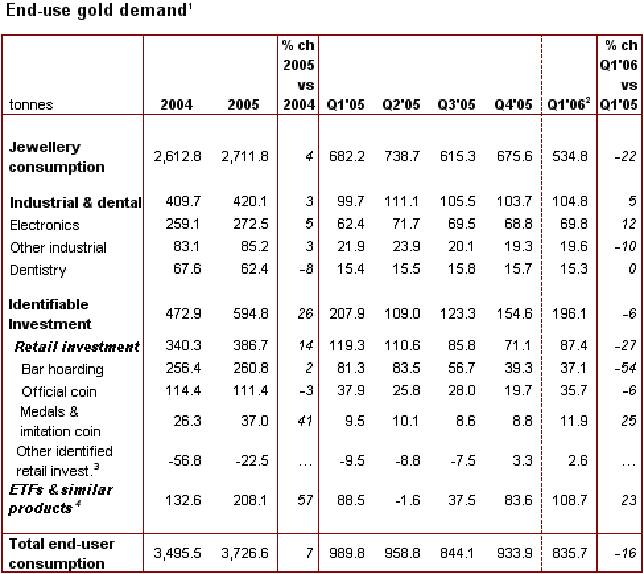
Where is Central Bank Buying Recorded?
You see folks, the World Gold Council – self professed as the world's authority on gold - has Identifiable Investment demand BARELY RISING in 2005 and actually declining year over year in Q1/06 despite this UBS report :
Russia leading global 'stealth demand' for gold
By Ambrose Evans-Pritchard (Filed: 05/06/2006 )
The world's big money brigade is snapping up gold bullion at eight times the rate originally thought, according to a report by UBS, the world's biggest gold trader.
The huge sums entering precious metals below the radar are likely to help to put a floor under the gold price after the dramatic fall of $112 an ounce in late May - the sharpest correction since the bull market began five years ago………….
THAT WAS 8 X THE RATE ORIGINALLY THOUGHT!!!! The World Gold Council reporting is COMPLETELY INCONSISTENT with IDENTIFIABLE , additional, reliable third party reporting ,
“To forestall an effort by the West to seize Iranian assets in Europe, the Iranian leadership decided last fall to begin a massive, secret repatriation of its international currency reserves, according to Central Bank of Iran documents.
The documents were obtained by an Iranian opposition group and shared with Newsmax.
The documents detail eight shipments in chartered jumbo jets from Zurich 's Kloten airport. The shipments, from October through late November, brought 250 tons of gold bullion from the vaults of Swiss banks to Tehran . “
The World Gold Council is so brash; in a crass attempt to absolve themselves of this blatant misreporting, they even go so far as to include in notes to the table above,
“Source: Tonnage data are GFMS Ltd. Value data are WGC calculations based on GFMS data. 1. Identifiable end-use consumption excluding central banks.”
Exclude hundreds of tons of Central Bank Buying from identifiable end demand? This is OUTRAGEOUS! But is gets even worse! The reality folks; blatant efforts were made to actually cut Iran off from buying more gold, when it was announced on Jan. 22, 2006
“Swiss banking giant UBS AG said Sunday it has stopped doing business with Iran because of the company's economic and risk analysis of the situation in the country. UBS will no longer deal with individuals, companies or state institutions such as Iran 's central bank, said company spokesman Serge Steiner. A similar policy is also being implemented in the case of Syria , he said……”
Crime of the Century?
How can ANYONE accept this kind of DECEPTIVE misreporting from the World Gold Council? This article, ALONE , readily identifies at least 250 TONS of [NEW] gold bullion purchases in Q4/05 while the world's “supposed” authority on gold says “net identifiable investment” was 154 tons? Claims of ignorance to this development could represent nothing short of Enron-esque effrontery on the part of the World Gold Council. What a sham! Actually, I'd really like to know why they bother publishing any numbers at all?
This blatant misreporting sheds light on the true nature of the tricks being played on an unsuspecting investing public where demand [and by extension the amount left in the vaults] for physical gold is and has been concerned. Armed with the knowledge outlined above, GATA has long maintained that the reported tonnage of gold held in Central Bank's vaults is much less than officially reported – with much of it being already lent out or swapped. In fact, in April 2006 the IMF published a paper , admitting that some of Central Bank hoards of monetary gold have in fact been “double counted”. Not a word from the World Gold Council on that, eh?
So folks, despite the recent plunge in the price of gold, it is really quite apparent that physical demand is stronger than ever. The games that are being played are largely being done in the paper [futures] market with noble assistance from “wolves in sheep's clothing” shills like the World Gold Council. These absurdities will CATEGOROCALLY come to an abrupt end when the quickly dwindling physical gold is gone.
Breakfast In America or Crisis, What Crisis?
If recent GATA suspicions that 450 – 525 tons of physical sovereign [U.S. gold on deposit at the I.M.F.] gold were mobilized with the Bank of England acting as sales agent to “bomb” the price of gold from its recent +700 dollar high, these games will not be played for much longer folks – you see, 500 ton caches of gold bullion are already rare birds and becoming more endangered every day.
I would like to add that if the above is true it also says much to the technicians out there who have been all too quick to claim that gold [and the metals complex] was due for such a correction. Metals prices have advanced due to the recklessness [to much printing] of monetary authorities – PERIOD . Claims that ANY MODEL accurately predicted the expulsion of an unexpected, illegal 500 ton dump of gold onto the market are baseless and without merit. If American I.M.F. gold was indeed mobilized, it would also appear that the requisite Congressional approval to do so was not sought. What a mess [or perhaps Constitutional Crisis would be more appropriate]!
If the world's gold producers have any interest, whatsoever, in promoting their product – they need to immediately sack The World Gold Council as their “advocate” for gold. THEIR CREDIBILITY IS LESS THAN ZERO. With friends like the World Gold Council, the world's gold producers certainly do not need any more enemies.
I've got a funny feeling that gold price suppression will ultimately have an end which will be much more financially devastating than Portfolio Insurance back in 1987. It's a simple case of the underlying assumptions [that there will always be enough sovereign physical gold to sell] are FALSE .
Seller beware! |
The Oil That Greases The Squeaky Wheel of Peak Oil
Of the earth's 57.4 million square miles of land mass , roughly 20 million square miles [about one third] of this land mass is located in the southern hemisphere.
The World's Top Ten [Known] Oil Resources:
Greatest Oil Reserves by Country, 2005
Rank |
Country |
Proved reserves
(billion barrels) |
1. |
Saudi Arabia |
261.9 |
2. |
Canada |
178.8 1 |
3. |
Iran |
125.8 |
4. |
Iraq |
115.0 |
5. |
Kuwait |
101.5 |
6. |
United Arab Emirates |
97.8 |
7. |
Venezuela |
77.2 |
8. |
Russia |
60.0 |
9. |
Libya |
39.0 |
10. |
Nigeria |
35.3 |
I've taken the liberty of adding the U.S. [former reserves], Mexico , Alaska and Norway [ North Sea ]: [more.....signup] [open pdf....members]
Addendum: The Oil That Greases The Squeaky Wheel of Peak Oil
Having received a couple of e-mails from folks claiming to know much more than myself about geology [which, by the way – is not hard to do] claiming that “it's all about sedimentary basins” and I'm simply not up to speed. I found this so comical, I would now like to share this with all you good folks. The passage below was from a reader who responded claiming to be a Ph.D. geologist:
“Sorry, but this is nonsense. There are very special geologic circumstances, large sedimentary basins in particular, that are conducive to large oil accumulations, and those simply don't occur to any great degree in the southern hemisphere. There's some possibility of oil on the broad South American continental shelf, of which the Falkland Islands are a high point . (The Argentines didn't want the Malvinas back because they wanted to herd sheep!) Other than that, though, there are few promising areas. That's just geology, and dark hints about Agendas by The Powers That Be simply demonstrate gross ignorance of both basic geologic data and of the geology of oil.”
So, I would now like to present to the geologists and laypeople alike in the crowd – a map of the world's sedimentary basins:
World map of sedimentary basins
Most of the world's sedimentary basins have been identified. Onshore basins are shown in green; offshore basins are lavender. The brown contour represents 1000-m [3300-ft] water depth. |
Proud To Support and Recommend GATA's Gold Rush 21 Conference DVD:
 |
|
Kirby's Recommended Reading
|
|
• Who is Rob Kirby? Read Rob Kirby's Profile.
• Bi-weekly Online Newsletter
Members receive email notification when a new e-letter (KANL) has been posted in the members-only section.
Become a member now.
• Preview Archives
Rob has been a ongoing contributor to Financial Sense Online for several years now. Browse Rob Kirby's archive of financial analysis articles.
|
|
![[Most Recent Quotes from www.kitco.com]](http://kitconet.com/images/quotes_2a.gif)